
call us 24/7 1-800-738-WE-WIN
call us 24/7 1-800-738-WE-WIN
Serving All of Georgia, Florida, & Texas
Georgia Truck Accident Laws on Driver Fatigue

Table of Contents
- How Driver Fatigue Causes Truck Crashes
- Georgia Truck Driver Hours of Service: Federal Rules That Apply
- Electronic Logging Device Records in a Truck Accident Claim
- Truck Driver Fatigue Evidence Beyond the Logbook
- Trucking Company Liability for Driver Fatigue
- Preserving Evidence After a Suspected Fatigue Crash
- Building a Fatigue Claim Under Georgia Truck Accident Laws
- Conclusion
- Frequently Asked Questions
Last Updated: October 17, 2026
How Driver Fatigue Causes Truck Crashes
Call the Merritt & Merritt Law Firm today at 404-975-1775. Offices in Atlanta, Savannah, Statesboro, and Houston.
Driver fatigue is reduced mental or physical alertness caused by sleep loss, long work hours, or untreated sleep disorders. At Merritt & Merritt Law Firm, we see how often fatigue sits behind a Georgia truck accident claim.
A drowsy driver at 65 mph covers roughly 95 feet every second, so a two-second lapse means nearly 200 feet of road gone unnoticed.
Fatigue does not always announce itself. Warning signs include:
- Drifting between lanes or onto the shoulder
- Missing exits or signs
- Repeated yawning and heavy eyelids
Those signs tell an investigator what to look for in dispatch data and witness statements.
Georgia Truck Driver Hours of Service: Federal Rules That Apply
Federal hours-of-service rules set the legal limits on a commercial driver’s workday. These rules come from the Federal Motor Carrier Safety Administration hours-of-service regulations and apply to interstate carriers operating in Georgia. A driver who stays within the limits can still be exhausted. The rules set a ceiling, not a guarantee of alertness.
Driving Limits, Off-Duty Periods, and the 34-Hour Restart
The core limits break down into a few numbers worth knowing:
- 11-hour driving limit: no more than 11 hours behind the wheel after 10 consecutive hours off duty
- 14-hour driving window: a driver cannot drive beyond the 14th hour after coming on duty
- 30-minute break: required after 8 cumulative hours of driving without at least a 30-minute interruption
Property-carrying drivers generally may not drive after 60 hours on duty in 7 straight days or 70 hours in 8 days. The FMCSA summary of driver hours-of-service rules lays out each limit in full.
A 34-hour restart does not erase fatigue. A driver can log the restart, then take the wheel still short on sleep. That gap is where many fatigue claims begin.
Electronic Logging Device Records in a Truck Accident Claim
Electronic logging device records are the digital, time-stamped record of a commercial driver’s hours. Since the electronic logging device mandate, most interstate carriers must use one to track driving time automatically. These records anchor any serious truck accident investigation.
What the records show:
- Engine-on and engine-off times
- Miles driven and vehicle motion
- Duty status changes through the day
What they miss is just as important. An electronic log cannot show how much sleep a driver actually got before the shift, a second job, a late-night drive, or a sleep disorder.
Truck Driver Fatigue Evidence Beyond the Logbook
Fatigue evidence rarely lives in one document. It comes from the edges of the record: messages, schedules, and the driver’s own conduct.
Look for:
- Dispatch records showing tight turnarounds or pressure to run
- Text and messaging logs from the hours before the crash
- Fuel and toll records that reveal the real schedule
A driver can comply with every hour-of-service limit and still be dangerously tired. When the log looks clean, the case often turns on schedule pressure, off-duty conduct, or a known medical issue the carrier ignored.
Trucking Company Liability for Driver Fatigue
A trucking company can be held responsible for a fatigued driver under several legal theories. The carrier is not automatically liable, but its own choices often create the exposure.
The main theories:
Schedule a Free Consultation →
- Negligent hiring: the carrier brought on a driver with a bad safety or medical history
- Negligent training: the driver was never properly taught rest and fatigue rules
- Negligent supervision: the carrier ignored red flags in the logs or complaints
Carrier liability is where the deepest evidence usually sits. Dispatch records and internal messages can show a company pushing drivers past safe limits to keep freight moving, the kind of proof that changes a settlement.
Preserving Evidence After a Suspected Fatigue Crash
Evidence in a fatigue case has a shelf life measured in days, not months. Electronic logs can be edited, onboard cameras overwrite on a loop, and drivers move on to the next load.
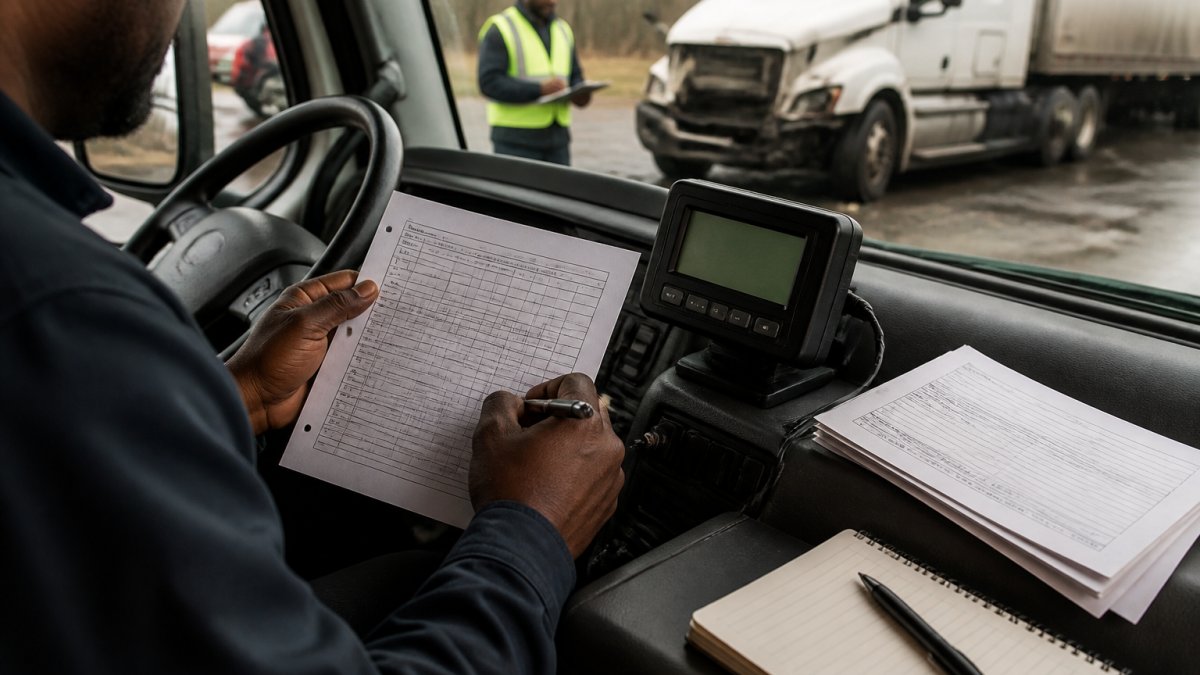
What to Preserve, by Evidence Type
The preservation demand should name each category specifically; a general request invites a general response.
- Electronic logging device data. Request the raw files, not a summary or a printed log. The raw data includes duty-status changes, edits, and gaps that a formatted log can hide.
- Dispatch and scheduling records. Load assignments, appointment times, and messages between dispatch and the driver reveal tight turnarounds and pressure to run.
- Onboard camera footage. Forward-facing and driver-facing cameras capture lane drift, late braking, and the driver’s appearance before impact, often the most persuasive fatigue evidence available.
- Engine control module and telematics data. Hard-brake events, speed at impact, and engine-on/engine-off times corroborate or contradict the log.
The Time-Sensitive Steps
- Send a spoliation letter immediately. A written demand puts the carrier on notice to preserve logs, dispatch data, camera footage, and driver records, and creates a record if evidence later disappears.
- Request the electronic log data in raw form. Ask for the underlying files and the audit trail, not a driver-produced printout.
- Preserve the truck and its onboard systems. Onboard cameras and engine computers hold data that is lost once the vehicle is repaired or sold.
- Gather witness contacts early. Memories fade and witnesses move; independent accounts of lane drift or speed matter later.
- Document the scene. Photos of skid marks, positions, and road conditions help the reconstruction.
- Get medical care and keep records. Injuries and symptoms support the damages claim and the causation link.
A common mistake is waiting weeks to act. By then, camera footage may have overwritten and log edits may be harder to detect. The FMCSA guidance on crash data and motor carrier records explains what carriers are required to keep and for how long, which helps frame a preservation demand.
Building a Fatigue Claim Under Georgia Truck Accident Laws
Georgia truck accident laws regarding driver fatigue sit at the intersection of federal safety regulation and state negligence law. The federal hours-of-service rules supply the standard of care and, when violated, evidence of negligence. Georgia law supplies the cause of action, fault-allocation rule, filing deadline, and damages framework. A fatigue claim has to work in both systems at once.
Which Rules Apply, and How They Interact
For an interstate carrier operating through Georgia, the Federal Motor Carrier Safety Administration’s hours-of-service regulations apply directly. For a purely intrastate carrier, Georgia has adopted its own rules that largely track the federal limits, so the analysis is similar even when the citation differs. Either way, the sequence is the same:
- Identify the governing standard. Confirm whether the carrier was operating interstate or intrastate, and which hours-of-service regime applied on the day of the crash.
- Measure compliance. Compare the driver’s electronic logging device record, dispatch records, and fuel and toll data against the applicable driving, on-duty, break, and restart limits.
- Show negligence per se where a violation exists. Under Georgia law, violation of a statute or regulation adopted for public safety can support a negligence per se theory when the violation caused the harm the rule was designed to prevent. A hours-of-service violation fits that framework when it is tied to the crash.
- Prove ordinary negligence where the log is clean. Compliance with the hours limits is not a defense to a fatigue claim. A driver can be exhausted within the legal ceiling, and the case then turns on schedule pressure, off-duty conduct, or a known medical condition.
That fourth point is where most fatigue claims are won. The log establishes the baseline; the surrounding evidence establishes the fatigue.
The Sequenced Claim-Building Path
A fatigue claim proceeds in a deliberate order, because each step depends on evidence secured in the one before it.
- Secure the record first. Send a spoliation demand and request raw electronic logging device files, dispatch data, onboard camera footage, and driver qualification files before they are overwritten or edited. (The next section covers this in detail.)
- Rebuild the timeline. Reconstruct the driver’s prior 72 hours, duty status, off-duty movement, fuel stops, toll pings, and messaging, to see whether the logged rest matches the actual rest.
- Prove fatigue, not just a violation. Use log gaps, late-night messaging, dashcam lane drift, witness accounts of weaving, and medical records suggesting an untreated sleep disorder. A clean log does not end the inquiry; it redirects it.
- Establish causation. Connect the fatigue to the specific driving error, a late brake, a lane departure, a missed stop, using the crash reconstruction and the vehicle’s engine control module data.
- Identify every liable party. The driver, the motor carrier, and in some cases a broker or shipper whose scheduling or coercion contributed to the fatigue. Carrier liability theories include negligent hiring, training, and supervision, and vicarious liability for a driver acting within the scope of employment.
- Document damages. Medical bills, lost earnings, future care, and pain and suffering. Fatigue crashes often involve catastrophic injury, so future-care projections matter.
- Negotiate, then litigate if needed. A demand built on preserved evidence and a clear causation link is what moves a carrier’s insurer; filing suit preserves leverage when the offer falls short.
Comparative Fault and Filing Deadlines
Georgia applies a modified comparative fault rule: a victim’s recovery is reduced by their own share of fault, and a victim found 50% or more at fault generally recovers nothing.
Deadlines are equally practical. Because the exact deadline can shift with the facts, and because claims against a government entity or an estate follow different rules, confirm the current limitation period in the Official Code of Georgia Annotated or with a lawyer rather than relying on memory.
Conclusion
Fatigue cases are won or lost on evidence, and that evidence fades quickly after a crash. If you or a loved one was hurt in a truck wreck, the clock is already running. Merritt & Merritt Law Firm brings over 45 years of trial experience to these claims, with 24-hour service and visits to your home, office, or hospital. We work on a contingency fee, so you pay only if we win.
Frequently Asked Questions
What laws apply to truck driver fatigue in Georgia?
Georgia truck accident laws regarding driver fatigue center on the federal hours-of-service rules enforced by the Federal Motor Carrier Safety Administration. These rules cap driving at 11 hours within a 14-hour on-duty window, require 10 consecutive hours off duty, and mandate a 30-minute break after 8 hours of driving. Georgia courts apply these federal standards when assessing negligence, and a violation can support a claim that the carrier or driver acted carelessly.
How many hours can a truck driver drive before taking a break?
Under current federal rules, a commercial driver must take a 30-minute break after 8 cumulative hours of driving without at least a 30-minute interruption. Driving is capped at 11 hours following 10 consecutive hours off duty, and all work must fit inside a 14-hour on-duty window. A driver may also use a 34-hour restart to reset the weekly cycle. Logging violations can become key truck driver fatigue evidence in a claim.
How can you prove a truck driver was fatigued after a crash?
Proof usually comes from several sources combined. Electronic logging device records truck accident investigations rely on show driving and duty status, while dispatch records, bills of lading, toll receipts, and fuel logs can reveal schedule pressure. Cell phone records, dashcam footage, and witness statements about weaving or slow reactions add context. An attorney can send spoliation letters to preserve these records before the carrier’s retention period expires.
Can a trucking company be liable for a fatigue-related accident?
Yes. Trucking company liability for driver fatigue can rest on negligent hiring, training, or supervision, and on company policies that push drivers to meet tight schedules. Carriers must comply with federal safety rules and are responsible for the conduct of their drivers within the scope of employment. If dispatch records show unrealistic deadlines or a pattern of log violations, that evidence can support a claim against the company as well as the driver.
Our Locations

Atlanta/Decatur
1 West Court Square
Suite 750
Decatur, GA 30030

Savannah
100 Bull Street
Suite 200
Savannah, GA 31401

Statesboro
15 West Main Street
Statesboro, GA 30458

Houston
1415 Louisiana Street,
Suite 1800,
Houston, TX 77002

Jacksonville
841 Prudential Drive
12th Floor
Jacksonville, FL 32207

Contact Us
© Copyright 2026 Merritt & Merritt Law Firm. All rights reserved.