
call us 24/7 1-800-738-WE-WIN
call us 24/7 1-800-738-WE-WIN
Serving All of Georgia, Florida, & Texas
Truck Driver Hours of Service Violations Explained

Table of Contents
- What Are Hours of Service Violations?
- Common HOS Violations List and Why They Happen
- How to Avoid DOT Hours of Service Violations
- FMCSA HOS Penalties and Enforcement
- HOS Violations During Adverse Driving Conditions
- Frequently Asked Questions
Last Updated: August 15, 2026
What Are Hours of Service Violations?
Call the Merritt & Merritt Law Firm today at 404-975-1775.
Hours of service violations occur when truck drivers exceed the maximum driving and on-duty limits set by the Federal Motor Carrier Safety Administration (FMCSA). These regulations combat driver fatigue, a leading cause of commercial vehicle accidents. Fatigued drivers experience slower reaction times, impaired decision-making, and significantly increased crash risk, which is why enforcement is taken seriously.
The 11-Hour Driving Limit
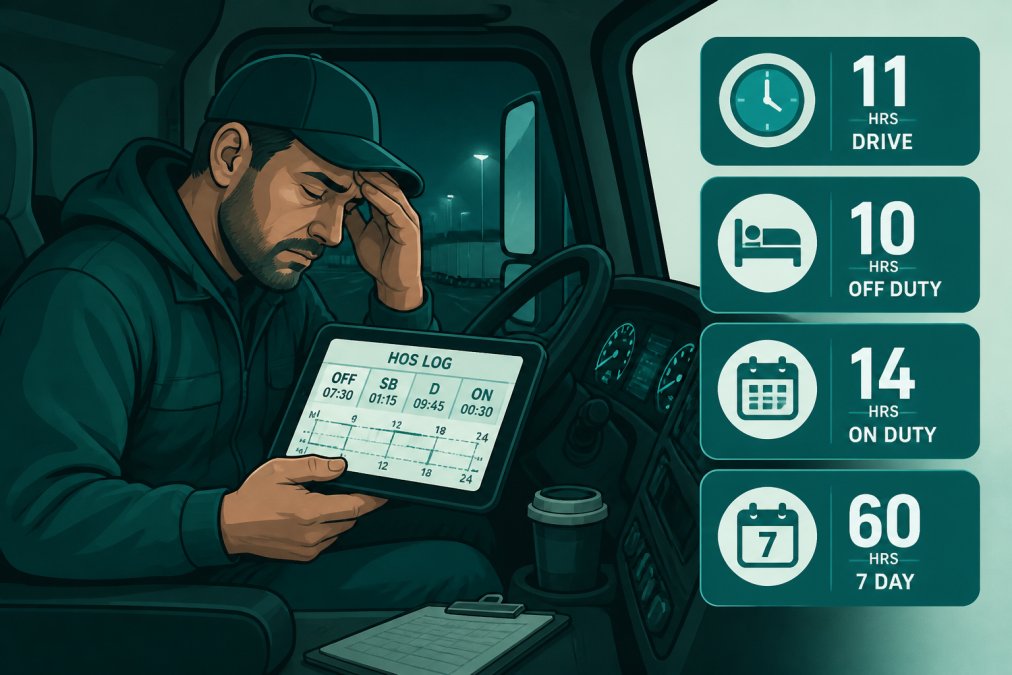
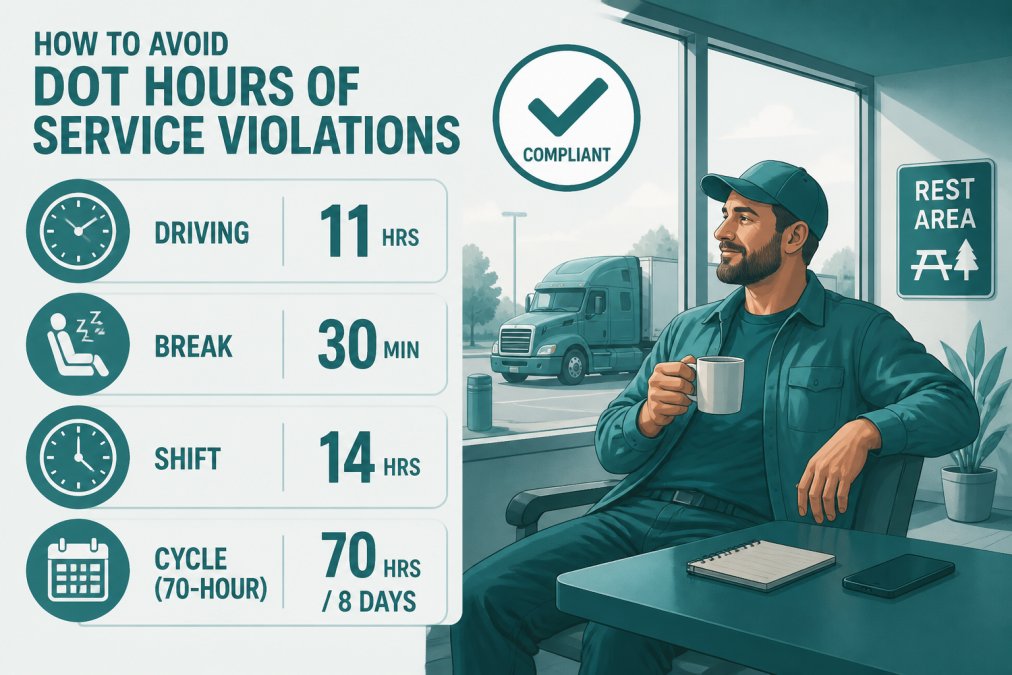
A truck driver cannot drive more than 11 consecutive hours after a 10-hour off-duty period. Once a driver reaches 11 hours of driving time, they must take a 10-hour break before resuming. Electronic Logging Devices (ELDs) have reduced violations from misunderstanding this rule, though they still occur.
The 14-Hour On-Duty Limit
Drivers cannot remain on duty for more than 14 consecutive hours, including both driving and non-driving work. On-duty time includes loading, unloading, fueling, maintenance checks, and paperwork. Many violations occur because drivers focus only on driving hours and ignore the broader on-duty window.
The 60/70-Hour Weekly Limits
Drivers cannot drive more than 60 hours in a 7-day period (or 70 hours in an 8-day period). After reaching these limits, drivers must take a 34-hour consecutive off-duty break before the clock resets. This break must include two periods between 1 a.m. and 5 a.m. to ensure meaningful rest.
The 30-Minute Break Requirement
After driving for 8 consecutive hours, drivers must take at least a 30-minute break. This break can be off-duty or sleeper berth time and must be taken before the 8-hour mark is reached.
Common HOS Violations List and Why They Happen
Hours of service violations fall into several categories. Understanding why they occur helps drivers and fleet managers prevent them.
Falsifying Logbooks and Electronic Records
Falsifying logbook records is one of the most serious violations. Drivers sometimes alter records to hide violations due to dispatcher pressure or impossible schedules. This carries severe consequences including civil penalties and potential criminal charges for repeat offenders. Falsified records undermine the entire safety system by hiding driver fatigue.
Sleeper Berth Violations
The sleeper berth provision allows drivers to split required off-duty time: one period must be at least 8 hours in the sleeper berth, and the other must be at least 2 hours of off-duty time. Drivers violate this rule by not meeting the 8-hour minimum or by not properly documenting split-duty periods.
Out-of-Service Orders and Driver Coercion
An out-of-service order prohibits a driver or vehicle from operating until violations are corrected. Drivers are sometimes coerced by dispatchers or management to drive while under an out-of-service order, a serious federal violation. The FMCSA takes coercion seriously because it contradicts the driver’s legal right to refuse unsafe work.
How to Avoid DOT Hours of Service Violations
Avoiding hours of service violations requires proper tools, realistic scheduling, and understanding the regulations.
Use Electronic Logging Devices (ELDs)
Electronic Logging Devices automatically record driving and on-duty time, eliminating manual errors. An ELD tracks location, engine status, and duty status in real time, alerting you before you exceed limits. Motive ELD offers real-time GPS tracking starting at $20-25 per month. Samsara ELD provides comprehensive fleet management at $27-33 per month. Matrack ELD starts at $19.95 per month with free hardware, while Garmin eLog offers a one-time purchase of $249.99 with zero monthly fees.
Plan Routes and Manage Your Schedule
Realistic route planning is foundational to compliance. Use mapping software that accounts for actual drive times, not just distances. Build in buffer time for rest stops, fuel, and unexpected delays. If a route requires more than 11 hours of driving, it must be split across two days with proper rest. Communicate with your dispatcher about realistic timelines; pressure to meet impossible deadlines is a major driver of violations.
Understand Exceptions and Exemptions
The FMCSA provides limited exceptions in specific situations. Short-haul exceptions apply to drivers operating within a 100-mile radius of their base. Personal conveyance allows drivers to move a vehicle for personal reasons without counting it as on-duty time. Yard moves don’t count as driving time. Adverse driving conditions allow up to 2 extra driving hours if you cannot safely reach your destination within remaining hours, but this doesn’t extend your 14-hour on-duty limit or weekly limits.
FMCSA HOS Penalties and Enforcement
Hours of service violations carry real financial and professional consequences.
Civil Penalties and Fines
The FMCSA assesses civil penalties based on violation severity and whether it’s a first offense or pattern. Penalties are assessed against both drivers and motor carriers. A company that pressures drivers to violate rules or fails to implement compliance systems faces corporate liability. Violations trigger increased scrutiny, potential loss of contracts, and higher insurance premiums.
CSA Scores and Safety Fitness Determination
The Compliance, Safety, Accountability (CSA) program tracks carrier safety performance. Carriers with poor CSA scores face increased enforcement attention and potential safety audits. A safety fitness determination assesses a carrier’s ability to operate safely. Carriers with serious or repeated HOS violations can be found unfit and lose their operating authority.
What to Do After a Violation
If you receive a citation, understand exactly what was violated and why. Document any mitigating circumstances such as dispatcher coercion, weather delays, or mechanical issues. Contact a transportation attorney who can review your case. If the violation is legitimate, work with your dispatcher to prevent recurrence through adjusted routes, better pre-trip planning, or improved ELD training.
HOS Violations During Adverse Driving Conditions
Adverse driving conditions include snow, ice, fog, rain, wind, dust, heavy traffic, road construction, and mechanical delays. If you cannot safely reach your destination within remaining hours, you can extend driving time by up to 2 hours. This exception applies only to your driving limit, not your 14-hour on-duty limit or weekly limits. Document conditions in your logbook or ELD notes. Excessive use of this exception suggests unsafe route planning or abuse.
Adverse Condition Type | Driving Limit Extension | On-Duty Limit Extension | Weekly Limit Extension |
|---|---|---|---|
Severe weather | Up to 2 hours | No extension | No extension |
Heavy traffic | Up to 2 hours | No extension | No extension |
Road construction | Up to 2 hours | No extension | No extension |
Mechanical delays | No extension | No extension | No extension |
Hours of service violations are preventable through proper planning, the right tools, and genuine commitment to compliance. The regulations protect you and everyone on the road; fatigue is a real hazard based on decades of safety research.
If you’ve received a citation for an hours of service violation and need legal guidance, Merritt & Merritt Law Firm is ready to help. Our team has over 45 years of trial experience representing drivers and trucking companies facing regulatory challenges. We offer 24-hour availability and can meet with you at your home, office, or hospital to review your case and explain your options. With a contingency fee structure, you pay only if we win. Schedule a free consultation today to discuss your situation with a legal expert who understands the trucking industry.
Frequently Asked Questions
What happens if you violate hours of service rules?
Hours of service violations can result in civil penalties ranging from hundreds to thousands of dollars for drivers and motor carriers. Violations also appear on your CSA (Compliance, Safety, Accountability) score, which affects your employment prospects and your carrier’s safety fitness determination. Serious or repeated violations may lead to out-of-service orders, preventing you from driving until compliance is restored. If you’ve been cited, consult with a qualified attorney to understand your specific situation and options for mitigation.
How long do HOS violations stay on your record?
HOS violations remain on your driving record and CSA profile for an extended period. While specific timelines depend on the violation severity and the carrier’s internal policies, violations can affect your employability and safety rating for years. If you’re facing a violation, it’s important to address it promptly. Legal representation can sometimes help negotiate reduced penalties or explore post-violation mitigation steps that may improve your record.
What is the 30-minute break requirement in HOS rules?
Federal HOS regulations require drivers to take a 30-minute break after 8 cumulative hours of driving. This break must be off-duty time or in the sleeper berth and cannot be used as part of your 11-hour driving window. The break resets your driving clock, allowing you to continue driving after the break is taken. Failing to take this mandatory break is a violation and can result in penalties and CSA points.
Can you adjust your HOS violation if you were forced to drive by your employer?
Driver coercion—when employers pressure drivers to violate HOS regulations—is illegal under federal law. If you were forced to drive beyond legal limits or falsify logs, you may have protections and potential defenses. However, this requires careful documentation and legal guidance. If you believe you were coerced into an HOS violation, contact an attorney immediately to discuss your situation, potential liability protection, and whether you have grounds for a claim against your employer.
Our Locations

Atlanta/Decatur
1 West Court Square
Suite 750
Decatur, GA 30030

Savannah
100 Bull Street
Suite 200
Savannah, GA 31401

Statesboro
15 West Main Street
Statesboro, GA 30458
Houston
1415 Louisiana Street,
Suite 1800,
Houston, TX 77002

Jacksonville
841 Prudential Drive
12th Floor
Jacksonville, FL 32207

Contact Us
© Copyright 2026 Merritt & Merritt Law Firm. All rights reserved.