
call us 24/7 1-800-738-WE-WIN
call us 24/7 1-800-738-WE-WIN
Serving All of Georgia, Florida, & Texas
How to Prove Negligence in Georgia Bicycle Accidents
Table of Contents
- Understanding Negligence in Bicycle Accident Claims
- Georgia Bicycle Laws and the Three-Foot Safe Passing Law
- Gathering Bicycle Accident Evidence at the Scene
- Using Bicycle Accident Witness Statements to Prove Fault
- Medical Records and Injury Documentation
- How to File a Bicycle Accident Claim in Georgia
- What to Do When Your Denied Bicycle Accident Claim Needs Appeal
- Frequently Asked Questions
Last Updated: October 15, 2026
Understanding Negligence in Bicycle Accident Claims
Call the Merritt & Merritt Law Firm today at 404-975-1775. Offices in Atlanta, Savannah, Statesboro, and Houston.
When a cyclist is hit by a car in Georgia, the driver may be legally responsible. But understanding how to prove negligence in Georgia bicycle accidents requires a clear framework. At Merritt & Merritt Law Firm, we’ve helped injury victims build strong cases by focusing on one simple framework: the four elements of negligence. (Source: Georgia’s Safe Passing Law)
Negligence is the legal concept that holds a person responsible for harm they caused through careless or reckless behavior. In a bicycle accident, you must prove four specific things to win compensation. Without all four, your claim will likely fail.
The Four Elements of Negligence
To prove negligence in a Georgia bicycle accident, you need to establish four elements. Each one is essential.
Duty of care is the first element. This means the driver had a legal obligation to act safely toward you.
Breach of duty is the second element. The driver violated that duty through careless or reckless action.
Causation is the third element. The driver’s breach directly caused your accident. This means the crash would not have happened without their negligent behavior.
Damages is the fourth element. You suffered real harm: medical bills, lost wages, pain and suffering, or property damage to your bicycle.
All four elements must be proven. A strong bicycle accident claim connects the dots between each one.
Driver Duty of Care Toward Cyclists
Every driver in Georgia has a legal duty to operate their vehicle safely. This duty extends specifically to cyclists sharing the road. The driver must see you, anticipate your movements, and avoid hitting you.
The duty of care includes basic responsibilities. Drivers must obey traffic laws. They must maintain control of their vehicle. They must watch for pedestrians and cyclists. They must not drive recklessly or impaired.
When a driver breaches this duty, they may be liable for your injuries. Common breaches include:
- Failing to yield at intersections or when turning
- Passing unsafely or too closely
- Swerving into a bike lane
- Driving under the influence
- Texting or using a phone while driving
- Driving at excessive speeds
- Ignoring traffic signals
A driver’s breach of duty is the foundation of your negligence claim. Without proof of breach, you cannot hold them responsible.
Georgia Bicycle Laws and the Three-Foot Safe Passing Law
Georgia has specific laws protecting cyclists. Understanding these laws strengthens your negligence claim. They establish the standard of care drivers must follow.
Georgia Code Section 40-6-294 is the state’s Safe Passing Law. It requires drivers to pass cyclists with at least three feet of clearance. This law is not optional.
When a driver passes within three feet of a cyclist, they violate this law. This violation is strong evidence of negligence.
The Safe Passing Law applies in all conditions. It applies on city streets and highways. It applies during day and night. It applies regardless of weather.
Other Georgia bicycle laws also matter:
- Cyclists have the right to use the full lane width
- Drivers cannot force cyclists off the road
- Cyclists must obey traffic signals and signs
- Cyclists can ride in the center of the lane when necessary for safety
Violations of these laws support your negligence claim. They show the driver acted carelessly. They demonstrate breach of duty.
Gathering Bicycle Accident Evidence at the Scene
The moments after your accident are critical. Evidence you collect now becomes proof later.
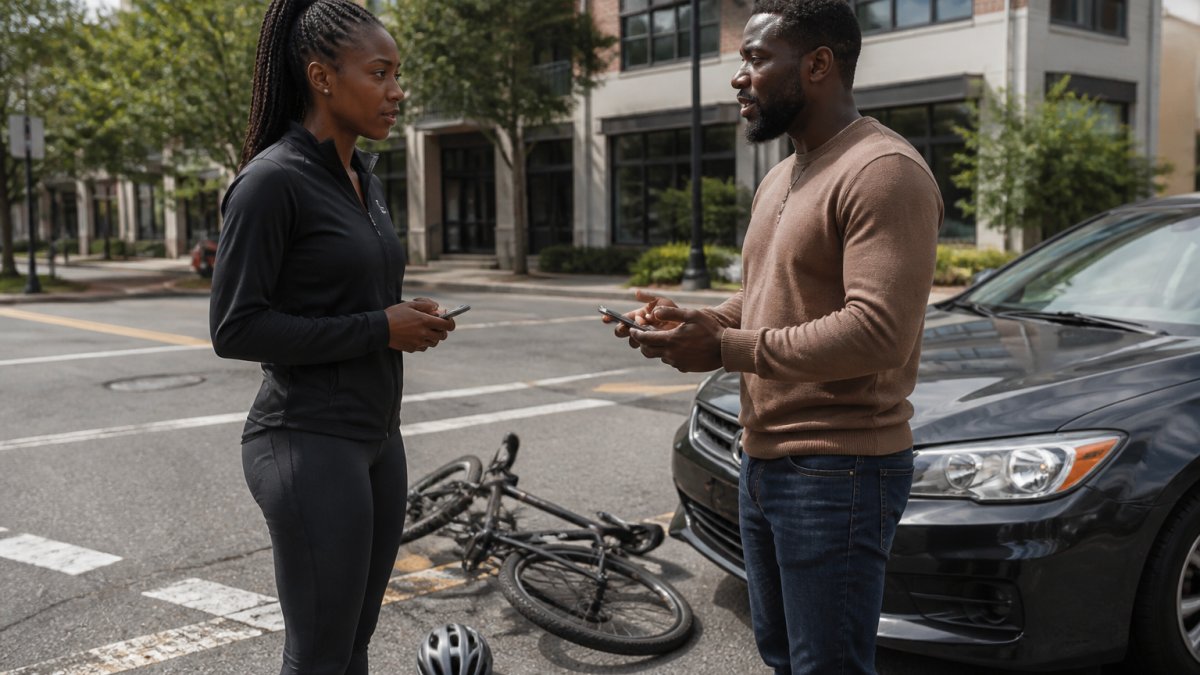
First, call 911. Report the accident to police. Request an officer come to the scene.
Next, get the driver’s information. Write down their name, phone number, address, and insurance details.
Document the scene thoroughly. Take photos of:
- The accident location and road conditions
- Your bicycle and any damage
- The driver’s vehicle and any damage
- Skid marks or debris on the road
- Traffic signals and street signs
- Road hazards or poor visibility
- Weather conditions at the time
- Time of day and lighting conditions
Photograph your injuries if visible. Take photos of cuts, bruises, or torn clothing. These images show the impact’s severity.
Write down what you remember while it is fresh. Note the date, time, and location. Describe how the accident happened.
Look for witnesses. Ask nearby people if they saw the crash. Get their names and phone numbers.
Preserve your clothing and bicycle. Do not wash or repair anything. These items may show evidence of impact or negligence.
Police Reports and Accident Documentation
A police report is one of the strongest pieces of evidence. It is an official record created by law enforcement. Courts give police reports significant weight.
The officer who arrives will interview you and the driver. They will examine the scene. They will document their findings in a written report.
The police report typically includes:
- Names and contact information for both parties
- Insurance information
- Descriptions of each vehicle and the bicycle
- Statements from both the driver and cyclist
- Witness statements if available
- Officer observations about the scene
- Citations issued to either party
- Diagrams of the accident location
- Weather and road conditions at the time
Request a copy of the police report. In Georgia, you can obtain it from the police department that responded. There may be a small fee.
A citation issued to the driver is powerful evidence. It shows an officer found the driver violated traffic law. This supports your negligence claim.
Do not discuss fault with the driver or their insurance company before consulting an attorney. Anything you say can be used against you later.
Scene Photographs and Video Footage
Visual evidence is compelling. Photos and videos show exactly what happened. They prove the accident occurred and document its severity.
Take multiple photos from different angles. Capture the overall scene. Then zoom in on specific details.
Look for surveillance cameras nearby. Businesses often have cameras on their buildings. Gas stations, convenience stores, and restaurants frequently record the street.
Check for traffic cameras. Some intersections have cameras that record traffic violations. The police may be able to obtain this footage.
Document the scene conditions. Show visibility from the driver’s position. Photograph sight lines.
Video footage is even more powerful than still photos. Upload it to a secure location. (Source: National Highway Traffic Safety Administration (NHTSA) data)
Using Bicycle Accident Witness Statements to Prove Fault
Witness statements are crucial evidence. They provide independent accounts of what happened. Witnesses have no stake in the outcome. Their credibility is high.
Schedule a Free Consultation →
At the scene, collect witness names, phone numbers, and email addresses. Ask them to describe what they saw.
Get written statements if witnesses are willing. Have them sign and date the statement. Include the date and time of the accident.
Witnesses can testify about:
- How the accident happened
- The driver’s speed and behavior
- Whether the driver obeyed traffic laws
- Visibility and road conditions
- The cyclist’s position and actions
- The impact and its severity
- The cyclist’s injuries
A witness who saw the driver pass unsafely is powerful. They can describe the distance between the vehicle and bicycle.
Multiple witnesses strengthen your case. Two or three independent accounts are harder to dispute than one.
Follow up with witnesses after the accident. Provide them with your attorney’s contact information.
Medical Records and Injury Documentation
Your medical records prove you were injured. They document the type and severity of harm. They establish the connection between the accident and your injuries.
Seek medical treatment immediately after the accident. Even if you feel okay, see a doctor. Some injuries develop over hours or days.
Keep all medical records:
- Emergency room reports
- Doctor visit summaries
- X-rays and imaging results
- Physical therapy records
- Prescription receipts
- Medical bills and invoices
Your medical records show the treatment you needed. They demonstrate the accident caused real harm. They support your claim for damages.
Document your recovery. Keep a journal of your pain, limitations, and progress. Note days you missed work. Record activities you could not do because of your injuries.
Photograph your injuries over time. Visual documentation shows the severity and healing process.
Medical evidence connects the driver’s negligence to your damages. Without it, proving harm becomes difficult.
How to File a Bicycle Accident Claim in Georgia
Filing a claim begins the compensation process. You will typically file against the driver’s insurance company.
Start by notifying the insurance company. Provide them with the accident details, police report number, and your contact information.
The insurance company will assign an adjuster. The adjuster investigates the claim. They review the police report, photos, and medical records.
The adjuster will make an initial offer. This offer is often low. Do not accept the first offer without evaluating it carefully.
Document all damages. Keep receipts for medical treatment, bicycle repairs, and other expenses. Calculate lost wages from missed work. Document pain and suffering honestly.
An experienced attorney can help you negotiate. They know what your case is worth. They can challenge the insurance company’s low offers.
Responding to Comparative Negligence Arguments
Georgia uses comparative negligence law. This means both parties can share fault for an accident. If you are found partially at fault, your compensation is reduced.
Insurance companies often argue the cyclist shares blame. They may claim you:
- Failed to wear a helmet
- Rode in poor visibility
- Did not obey traffic laws
- Were distracted while riding
- Rode in an unsafe manner
These arguments are common. They are often weak. But you must be prepared to respond.
Evidence that rebuts comparative negligence claims includes:
- Proof you obeyed traffic laws
- Witness statements supporting your actions
- Photos showing good visibility
- Medical evidence of the impact’s severity
- Expert analysis of the accident mechanics
A helmet does not cause an accident. Wearing or not wearing a helmet does not prove negligence. Georgia courts recognize this distinction.
Your attorney can counter comparative negligence arguments. They can present evidence of the driver’s clear fault. They can show the driver violated the Safe Passing Law or other traffic laws.
What to Do When Your Denied Bicycle Accident Claim Needs Appeal
Sometimes insurance companies deny claims. They may claim the driver was not at fault.
A denial is not the end. You have options. You can appeal the decision.
Review the denial letter carefully. Understand the reason for denial.
Gather additional evidence. Obtain statements from witnesses you have not yet contacted.
Send a written appeal to the insurance company. Include new evidence.
Consider hiring an attorney if you have not already. An attorney can review your case.
A lawsuit forces the insurance company to defend their position. You can depose witnesses.
Many cases settle before trial. But the threat of trial often motivates settlement.
At Merritt & Merritt Law Firm, we’ve represented injury victims throughout Georgia for over 45 years.
Frequently Asked Questions
What evidence can prove negligence in a bicycle accident?
Evidence proving negligence includes police reports documenting the driver’s violations, witness statements describing what they saw, photographs of the accident scene and vehicle damage, video footage from surveillance or dashcams, medical records showing your injuries, traffic citations issued to the driver, and documentation of traffic law violations such as failure to yield or unsafe passing. The strongest claims combine multiple forms of evidence showing the driver breached their duty of care.
How do you file a bicycle accident claim in Georgia?
File a claim by first reporting the accident to police and obtaining a report number. Document all evidence immediately: photographs, witness contact information, and medical treatment records. Notify the at-fault driver’s insurance company within a reasonable timeframe, providing the police report and your evidence. If the insurer denies or undervalues your claim, you can file a formal appeal with supporting documentation or pursue legal action. An attorney can handle the filing process and negotiate on your behalf.
What if the driver denies causing the bicycle accident?
When a driver denies fault, witness statements become critical. Eyewitnesses who saw the collision, the driver’s actions, and road conditions can contradict the driver’s account. Video footage from nearby cameras, traffic violations documented in the police report, and physical evidence (damage patterns, debris location) also support your version. If the driver violated Georgia’s three-foot Safe Passing Law or failed to yield, that violation helps establish negligence even if they deny intent.
Can my bicycle accident claim be denied in Georgia, and what can I do about it?
Yes, insurers can deny claims if they argue the cyclist was at fault or that injuries don’t match the accident. Challenge a denial by gathering additional evidence, obtaining medical expert opinions linking injuries to the collision, and submitting a formal appeal with documentation. If comparative negligence is claimed, evidence showing the driver’s violations and your compliance with traffic laws rebuts that argument. Legal representation strengthens appeals and can compel the insurer to reconsider or escalate to litigation.
Our Locations

Atlanta/Decatur
1 West Court Square
Suite 750
Decatur, GA 30030

Savannah
100 Bull Street
Suite 200
Savannah, GA 31401
Statesboro
15 West Main Street
Statesboro, GA 30458
Houston
1415 Louisiana Street,
Suite 1800,
Houston, TX 77002

Jacksonville
841 Prudential Drive
12th Floor
Jacksonville, FL 32207

Contact Us
© Copyright 2026 Merritt & Merritt Law Firm. All rights reserved.