
call us 24/7 1-800-738-WE-WIN
call us 24/7 1-800-738-WE-WIN
Serving All of Georgia, Florida, & Texas
File a Slip and Fall Claim: Step-by-Step Guide

Table of Contents
- Immediate Actions: What to Do After a Slip and Fall
- Understanding Premises Liability and Negligence
- Proving Negligence in Your Slip and Fall Case
- Steps to File Your Slip and Fall Claim
- Statute of Limitations for Slip and Fall Claims
- Calculating Slip and Fall Compensation
- When to Hire a Personal Injury Attorney
- Common Mistakes to Avoid When Filing a Slip and Fall Claim
File a Slip and Fall Claim: Step-by-Step Guide
Last Updated: July 24, 2026
When you slip and fall on someone else’s property, the aftermath can feel overwhelming. You’re dealing with pain, medical bills, and uncertainty about what comes next. This guide from Merritt & Merritt Law Firm walks you through exactly how to file slip and fall claim and protect your rights. Understanding the process separates those who get compensated from those who settle for far less than they deserve.
The path to a successful claim requires precision: gather evidence, document injuries, communicate strategically with insurance adjusters, and understand the legal framework governing premises liability.
Call the Merritt & Merritt Law Firm today at 404-975-1775. Offices: Atlanta | Savannah | Statesboro | Houston
Immediate Actions: What to Do After a Slip and Fall
The moments immediately following a slip and fall accident determine whether you have a strong claim or a weak one.
Safety First: Assess Your Condition
Your health comes before documentation. Sit or lie down where you fell and assess your condition. If you have any doubt, call 911. Refusing medical attention at the scene is a critical mistake, adrenaline masks injuries. A medical report created immediately after the incident becomes your foundation for the entire claim.
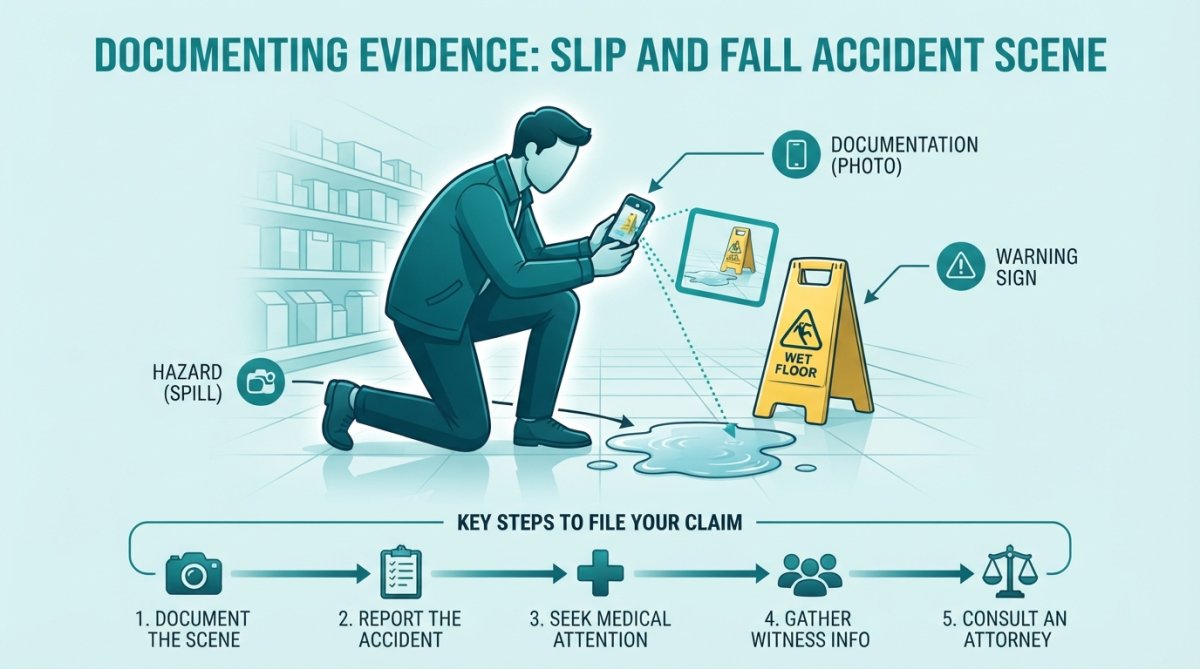
Document the Scene and Gather Information
Take photographs and video from multiple angles:
- The hazard that caused your fall (wet floor, broken step, debris, ice)
- The surrounding area showing poor maintenance or lack of warning signs
- Lighting conditions at the time
- Any visible injuries on your body
- The property address and entrance
Get the names and contact information of anyone who witnessed your fall. Witnesses are invaluable to an insurance adjuster. Get the name and position of any property manager or employee present, and ask for an incident report.
Ask the property owner or manager: “Was this hazard reported before? Has anyone else fallen here?” Their answer tells you something important about their knowledge of the danger.
Understanding Premises Liability and Negligence
Property owners have a legal obligation called duty of care, they must maintain their premises in a reasonably safe condition and warn visitors of known hazards. When they fail to do this and someone gets injured, that’s premises liability.
Negligence has four components: the property owner owed you a duty of care (almost always true if you were invited onto the property), they breached that duty by failing to maintain safe conditions or warn of hazards, their breach directly caused your fall, and you suffered damages.
The critical question isn’t whether you fell. It’s whether the property owner knew (or should have known) about the hazard and failed to fix it or warn you. A wet floor from a customer’s spilled drink five minutes ago is different from one that’s been there for an hour.
Comparative fault matters too. Some states allow you to recover damages even if you were partially responsible. If you were texting and didn’t see a wet floor sign, you might be 20% at fault but still recover 80% of your damages. Other states bar recovery entirely if you’re more than 50% at fault.
Proving Negligence in Your Slip and Fall Case
Proving negligence requires evidence that connects the property owner’s failure directly to your injury.
Establishing the Property Owner’s Duty of Care
The property owner’s duty of care depends on your status when you fell. If you were an invited guest or customer, they owed you a high duty of care. The property owner must inspect their premises regularly, repair hazards promptly, warn customers of temporary dangers, maintain adequate lighting, and remove debris and obstacles.
In commercial settings, this duty is well-established. In residential settings, the duty is lower, a homeowner isn’t expected to inspect as frequently as a business, but it still exists. If a homeowner knows a step is broken and doesn’t fix it, and you’re injured on that step, they’ve breached their duty.
Demonstrating Breach and Causation
Breach means the property owner failed to meet their duty. Evidence of breach includes:
- No inspection schedule for the area where you fell
- No maintenance records showing repairs or cleaning
- Witness testimony that the hazard existed for hours
- Similar prior incidents at the same location
- Violation of industry safety standards
- Security camera footage showing the hazard
Causation is straightforward: the hazard directly caused your fall. The property owner’s negligence must be the direct cause of your injury.
Steps to File Your Slip and Fall Claim
Filing a claim is a structured process with specific deadlines and requirements.
Step 1: Gather Medical Documentation and Evidence
Your medical records are the foundation of your claim’s value. Collect:
- Emergency room or urgent care reports from the day of the accident
- Doctor’s notes from all follow-up visits
- Diagnostic imaging (X-rays, MRI, CT scans)
- Physical therapy records
- Medication prescriptions
- Medical bills and invoices
- Proof of lost wages (pay stubs showing hours missed)
- Documentation of ongoing treatment
Preserve all physical evidence related to the fall. Keep the shoes you were wearing and photographs of any visible injuries.
Step 2: Notify the Property Owner and File an Incident Report
Ask for an incident report immediately after your fall, or request it within 24 hours. This creates an official record that the property owner knew about the accident.
Send a written notice to the property owner via certified mail. State the date, time, and location of your fall, describe the hazard, and list your injuries. Keep the tone factual, not accusatory.
Example: “On July 15, 2026, I fell on the wet floor near the produce section of [store name] at [address]. No wet floor sign was present. I sustained injuries to my left ankle and back. I received medical treatment at [hospital name].”
Do not admit fault or apologize for the fall.
Step 3: Preserve Digital Evidence and Witness Statements
Contact witnesses before they disappear. Get their full names, phone numbers, and email addresses. Ask if you can record a brief statement.
Request security camera footage from the property. Send a written request for preservation of all video from the date and time of your fall to the property owner’s legal department or management company.
Photograph your injuries as they heal. Take pictures every few days for the first two weeks to document the severity of your injuries.
Step 4: Communicate With Your Insurance Adjuster
The property owner’s insurance company will contact you. Do not speak with them without legal representation.
Insurance adjusters are trained negotiators. They’ll ask you to give a recorded statement, sign medical authorization forms, and offer a quick settlement. Every single one of these is designed to minimize what you recover.
When the insurance adjuster calls, say: “I’m represented by an attorney. Please direct all communication to them.” Then hang up.
If you haven’t hired an attorney yet, do it now. At Merritt & Merritt Law Firm, we handle slip and fall claims on contingency, you pay nothing unless we win. We communicate with adjusters so you don’t have to.
Statute of Limitations for Slip and Fall Claims
The statute of limitations is the legal deadline to file a lawsuit. Miss this deadline and your claim is gone forever.
In most states, the statute of limitations for slip and fall claims is two to three years from the date of your injury. The clock starts the day you fall, not the day you discover your injury.
This doesn’t mean you need to file a lawsuit immediately. Most slip and fall claims settle before trial. But your attorney needs to file a lawsuit before the deadline expires to preserve your rights.
Calculating Slip and Fall Compensation
Your compensation falls into two categories: economic damages and non-economic damages.
Economic Damages: Medical Bills and Lost Wages
Economic damages are straightforward to calculate because they have receipts:
- All medical treatment costs (emergency room, doctor visits, imaging, surgery, physical therapy)
- Prescription medications
- Medical equipment (crutches, braces, wheelchairs)
- Transportation to medical appointments
- Lost wages from missed work
- Reduced earning capacity if your injury causes permanent limitations
Add up every bill. Request itemized statements from your healthcare providers. Lost wages are calculated by multiplying your hourly rate by the number of hours you missed.
Non-Economic Damages: Pain and Suffering
Non-economic damages include:
- Physical pain from your injury
- Emotional distress and anxiety
- Loss of enjoyment of life
- Permanent scarring or disfigurement
- Reduced quality of life
Insurance adjusters use the multiplier method: take your economic damages and multiply by 1.5 to 5, depending on injury severity. A mild injury might use a 1.5 multiplier. A severe injury might use a 4 or 5 multiplier.
Example: Your economic damages are $50,000. A moderate injury might warrant a 2.5 multiplier, giving you $125,000 in pain and suffering. Your total claim value is $175,000.
Injury Severity | Economic Damages | Typical Multiplier | Pain & Suffering | Total Claim Value |
|---|---|---|---|---|
Minor (sprains, bruises) | $10,000 | 1.5-2.0 | $15,000-$20,000 | $25,000-$30,000 |
Moderate (fractures, surgery) | $50,000 | 2.5-3.5 | $125,000-$175,000 | $175,000-$225,000 |
Severe (permanent injury) | $100,000+ | 4.0-5.0+ | $400,000-$500,000+ | $500,000-$600,000+ |
When to Hire a Personal Injury Attorney
You should hire an attorney immediately after your slip and fall. Insurance adjusters are trained to minimize claims. They’ll contact you before you’ve fully recovered, when you’re vulnerable and desperate for money, and offer a settlement that doesn’t cover your future medical care or lost earning capacity.
An attorney levels the playing field. We know what your claim is actually worth and communicate with adjusters in language they understand.
At Merritt & Merritt Law Firm, we’ve handled thousands of slip and fall cases over 45 years. We investigate your claim thoroughly, gathering evidence the property owner hopes you’ll never find. We work on contingency, you pay nothing unless we win.
The question isn’t whether you can afford an attorney. The question is whether you can afford not to have one.
Common Mistakes to Avoid When Filing a Slip and Fall Claim
Giving a recorded statement to the insurance adjuster. You have no obligation to speak with them. Anything you say will be used against you. Let your attorney do the talking.
Posting about your injury on social media. The insurance company will find your accounts and use photos of you at restaurants or hiking as evidence that your injury isn’t as severe as you claim. Don’t post anything about your injury, recovery, or daily activities.
Accepting the first settlement offer. Insurance companies make lowball offers knowing most people will accept them. Their first offer is typically 30-50% below what the claim is actually worth. Negotiate. If negotiations stall, file a lawsuit.
Waiting too long to file a claim. Evidence disappears. Witnesses move away. Your memory fades. File your claim within 30 days of your injury.
Failing to get medical treatment. If you didn’t see a doctor immediately after your fall, the insurance company will argue your injuries aren’t serious. Get medical care even if you think you’re okay.
Signing medical authorization forms from the insurance company. These forms give the insurance company access to your entire medical history. Let your attorney handle medical authorizations.
Trying to handle the claim yourself. You’re not trained in insurance law. The insurance company knows you’re unrepresented and will exploit that advantage. Hire an attorney.
A slip and fall on someone else’s property shouldn’t derail your life. The property owner has insurance for exactly this reason. But getting what you deserve requires strategy, documentation, and legal representation.
Merritt & Merritt Law Firm has recovered millions for slip and fall victims over four decades. We investigate claims thoroughly, negotiate aggressively, and litigate when necessary. We offer 24-hour availability and can meet you at your home, office, or hospital. Most importantly, you pay nothing unless we win.
Schedule a free consultation today and let us handle the fight. Your recovery is our priority.
Frequently Asked Questions
What should I do immediately after a slip and fall accident?
First, assess your physical condition and seek medical attention if injured. Report the incident to the property owner or manager and request an incident report. Take photographs of the hazard that caused your fall, document the scene, and collect contact information from any witnesses. Avoid discussing fault or signing documents without legal review. Keep records of all medical visits, expenses, and communications related to your slip and fall claim.
How long do I have to file a slip and fall claim under the statute of limitations?
The statute of limitations for slip and fall claims varies by state, typically ranging from two to four years from the date of injury. Some states impose shorter deadlines for claims against government entities. Missing this deadline can permanently bar your right to recover compensation. Consult with a personal injury attorney immediately to understand your specific statutory deadline and ensure your claim is filed timely.
What evidence do I need to prove negligence in a slip and fall case?
You must establish that the property owner breached their duty of care, which caused your injuries. Key evidence includes photographs of the hazard, medical documentation of your injuries, witness statements, incident reports, maintenance records, and surveillance footage if available. Digital evidence preservation—such as timestamped photos and videos—strengthens your case. You must show the owner knew or should have known about the dangerous condition and failed to correct it or warn you.
What types of compensation can I recover from a slip and fall claim?
You may recover compensatory damages, including economic damages (medical bills, lost wages, rehabilitation costs) and non-economic damages (pain and suffering, emotional distress, loss of enjoyment). Your settlement demand should reflect the full extent of your bodily injury and its impact on your life. An insurance adjuster will evaluate your claim based on injury severity, liability strength, and comparable cases. An experienced personal injury attorney can help you negotiate fair compensation and avoid accepting inadequate settlement offers.
Our Locations

Atlanta/Decatur
1 West Court Square
Suite 750
Decatur, GA 30030

Savannah
100 Bull Street
Suite 200
Savannah, GA 31401

Statesboro
15 West Main Street
Statesboro, GA 30458

Houston
1415 Louisiana Street,
Suite 1800,
Houston, TX 77002

Jacksonville
841 Prudential Drive
12th Floor
Jacksonville, FL 32207

Contact Us
© Copyright 2026 Merritt & Merritt Law Firm. All rights reserved.