
call us 24/7 1-800-738-WE-WIN
call us 24/7 1-800-738-WE-WIN
Serving All of Georgia, Florida, & Texas
What Happens During a Personal Injury Deposition

Table of Contents
- What Happens During a Personal Injury Deposition: Key Steps
- Who Is Present in the Room and Why It Matters
- Deposition Questions in Personal Injury Cases: What Gets Asked
- How Long Does a Deposition Take?
- Tips for a Personal Injury Deposition: Handling Trick Questions and Stress
- Virtual vs. In-Person Depositions: What Changes
- What Happens After the Deposition
- Frequently Asked Questions
Last Updated: October 3, 2026
What Happens During a Personal Injury Deposition: Key Steps
A personal injury deposition is a formal, out-of-court proceeding where attorneys question you under oath about your accident, injuries, and their impact on your life. Your answers become sworn testimony usable in settlement negotiations or at trial.
The deposition is part of discovery, the pretrial phase where both sides exchange information. A personal injury deposition usually happens in a conference room at a law office, not before a judge, no jury, no gavel, no verdict.
A deposition is not a conversation. Everything you say is recorded verbatim and can be read back to a jury. Treat every answer as permanent.
The Deposition Notice and Scheduling
The process begins with a deposition notice, a formal document telling you when, where, and how the deposition will occur. Attorneys for both sides coordinate dates, usually weeks or months after the lawsuit is filed so both sides can gather medical records, bills, and evidence. If you’re still treating, your lawyer may ask to postpone until your condition stabilizes, since your testimony about pain and recovery should reflect your current medical picture.
The Sworn Statement and Oath
Before questioning starts, the court reporter places you under oath, the same oath used in a courtroom. Once sworn, any deliberate falsehood is perjury, a criminal offense. Answer honestly and completely; if you don’t remember something, “I don’t recall” is a legitimate answer.
Who Is Present in the Room and Why It Matters
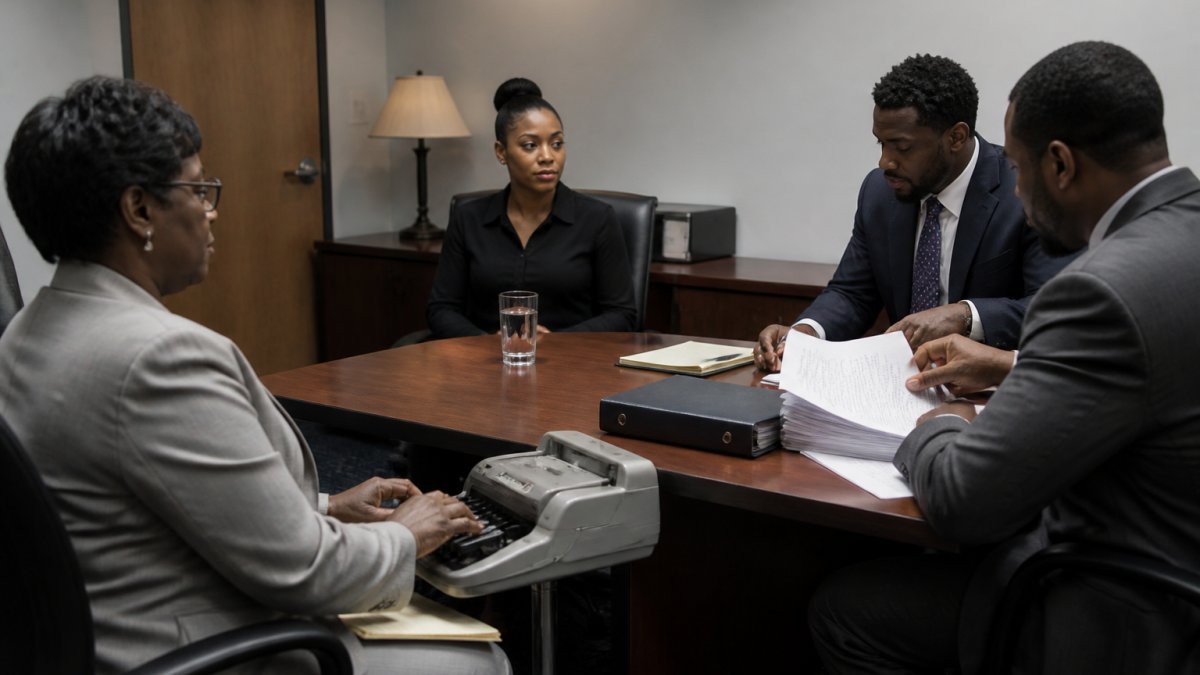
A typical personal injury deposition includes you, your attorney, opposing counsel, and a court reporter; some also involve a videographer. The room is usually a standard conference room, informal in appearance but formal in procedure.
The Court Reporter and the Transcript
The court reporter administers the oath and creates a verbatim transcript of every word spoken, capturing questions, answers, and objections. That transcript becomes part of the case file and can be read aloud at trial or used in settlement negotiations. Because it’s exact, avoid jokes, sarcasm, and offhand remarks. Speak clearly, let your attorney finish objections before answering, and pause briefly after each question.
Opposing Counsel, Your Attorney, and the Video Camera
Opposing counsel asks the questions. Your attorney sits beside you, objects when appropriate, and can confer with you during breaks. If the deposition is videotaped, the recording may be played for a jury later, so your tone, expressions, and body language all become part of the record. Dress as you would for court, sit upright, and keep your composure even when questions feel pointed.
Deposition Questions in Personal Injury Cases: What Gets Asked
Deposition questions in personal injury cases cover your background, the accident, your injuries, and your treatment. Expect questions about employment, prior injuries, and daily activities before and after the incident. Opposing counsel will probe for inconsistencies and pre-existing conditions. Answer truthfully and narrowly, don’t volunteer information or speculate. Common topics include:
- How the accident happened and who was involved
- The injuries you sustained and when symptoms appeared
- Every medical provider you’ve seen and the treatment received
Opposing counsel’s goal is fact-finding for the defense and, at times, impeachment, building a record to challenge your credibility later. Consistency with your medical records and prior statements is essential. If you’ve given a recorded statement to an insurer, tell your attorney beforehand.
How Long Does a Deposition Take?
A personal injury deposition commonly lasts one to four hours, though complex cases involving catastrophic injuries or multiple parties can run longer. Most finish in a single session; some continue over multiple days. Length depends on the number of issues, the volume of medical treatment, and how many questions opposing counsel wants to cover. Ask for a break if you’re tired or need to collect your thoughts, fatigue leads to mistakes, and mistakes in a transcript are hard to undo.
Tips for a Personal Injury Deposition: Handling Trick Questions and Stress
The best preparation is honest, controlled answers. Listen to the full question, take a breath, and answer only what’s asked. If you don’t know, say so; if you don’t understand, ask the attorney to rephrase. Never guess at dates, distances, or dollar amounts. Here are practical tips we give our own clients:
- Tell the truth, always. Fabrication destroys credibility.
- Answer yes or no when possible, then stop.
- Don’t argue with opposing counsel.
Recognizing Trick Questions Before You Answer
Most “trick” questions aren’t clever, they’re traps built from assumptions. Opposing counsel wants you to adopt a fact you never agreed to, lock in an absolute, or estimate a number you can’t know. Watch for these patterns:
- The loaded premise. “You were only going about five miles over the speed limit, right?” The question smuggles in a fact (that you were speeding at all). Don’t accept the premise. Say, “I don’t agree with that characterization,” or ask your attorney to let you clarify.
- The absolute. “You’ve never had any pain in your back before this accident?” Words like never, always, and every invite a yes that a single medical record can later contradict. Answer narrowly: “Not that I recall” or “Not that I was treated for.”
- The compound question. “You went to the store and you weren’t wearing a seatbelt, correct?” Two questions, one answer. Ask the attorney to break it up so you can answer each part separately.
How to Pause, Confer, and Protect the Record
You have more control than you think:
Schedule a Free Consultation →
- Pause two to three seconds after every question. This gives your attorney time to object, gives you time to think, and breaks counsel’s rhythm.
- Ask to confer with your attorney. In most jurisdictions, you may consult with your lawyer about a pending question, though some courts limit this to specific circumstances. If you’re unsure how to answer, say, “May I speak with my attorney?”
- Ask for a break. You can request one at any time, for water, a restroom, or to collect yourself. Breaks are typically off the record, and your attorney can use them to coach you.
- Let your attorney object. When counsel objects, stop talking. Wait for your lawyer to finish and for the question to be re-asked or withdrawn. Never talk over an objection.
- Correct the record immediately. If you misspeak, say so before the next question: “I want to correct my last answer.” A correction on the record is far better than an inconsistency the defense uses at trial.
A common mistake is trying to “win” the deposition by out-arguing opposing counsel. The consequence: you appear combative, and the jury later sees it on video. Let your attorney handle objections and legal arguments.
Managing Anxiety Before and During the Deposition
Nervousness is normal, but preparation reduces it. Meet with your attorney beforehand to review likely questions and your case file, get a full night’s sleep, eat beforehand, and bring water. During the deposition, breathe slowly and take your time; if a question triggers stress, pause and let your attorney object. Many clients find the reality far less intimidating than the anticipation.
A few anxiety-specific tactics that help:
- Rehearse out loud, not just in your head. Reading records silently doesn’t build the muscle memory of speaking answers aloud; a mock session with your attorney does.
- Write down your three hardest topics, the injury you’re most worried about, the prior claim you’d rather forget, the gap in treatment, and practice answering them until the words feel routine.
- Use a grounding cue. When stress spikes, plant both feet on the floor, take one slow breath, and answer. This interrupts the fight-or-flight response that makes people rush or over-explain.
Virtual vs. In-Person Depositions: What Changes
Virtual depositions by video conference have become standard in personal injury litigation, and the core rules stay the same: you’re still under oath, still on the record, and still bound to tell the truth. What changes is the setting, the technology, and how opposing counsel reads your face on a screen.
Setting Up a Remote Deposition That Doesn’t Hurt You
A remote deposition is still formal, and the camera captures more than you think. Before the day arrives:
- Choose a quiet, private room with a door you can close. No pets, children, or roommates in the frame. A neutral wall behind you is ideal, avoid a bedroom or kitchen.
- Test your connection, camera, and microphone the day before. Use the same platform the deposition will run on (Zoom and Microsoft Teams are most common), and confirm your audio is clear and video isn’t grainy.
- Light your face, not your back. Sit facing a window or a lamp so your expression is visible. Backlighting turns you into a silhouette and reads as evasive.
On-Camera Discipline: Where Remote Testimony Goes Wrong
The biggest difference between remote and in-person is that the camera never blinks. In a conference room, a raised eyebrow or a sigh may go unnoticed. On video, it’s captured and can be played for a jury. A few rules:
- Look at the camera when you answer, not at the screen. It feels unnatural, but it’s the only way to make eye contact with the attorney questioning you. Glancing at your own image reads as vanity; glancing at others reads as evasion.
- Don’t read from notes. Unless your attorney has approved specific documents, anything you read on camera looks like a script. If you need to reference a medical record, tell your attorney in advance so it can be handled properly on the record.
- Pause longer than you would in person. Video lag means an objection from your attorney may arrive a beat after the question. Wait a full two to three seconds before answering, longer than feels natural.
- Keep your hands visible and still. Fidgeting, touching your face, or covering your mouth all read as nervousness on camera. Rest your hands on the desk in front of you.
When In-Person Still Makes More Sense
Remote depositions aren’t always the right call. In-person testimony lets your attorney communicate through subtle signals that don’t translate through a screen, and it removes the risk of a dropped connection. If you’re recovering at home or in a hospital, remote may be your only practical option, and courts routinely accommodate that. If you can attend in person and your attorney recommends it, the controlled conference-room environment is often safer.
What Happens After the Deposition
Once questioning ends, the court reporter finalizes the transcript, and you may have the chance to review it for accuracy. Your attorney receives a copy, and it becomes part of the case file.
If you’re facing a personal injury deposition and want an experienced trial team beside you, Merritt & Merritt Law Firm is ready to help. With over 45 years of trial experience, we offer 24-hour service and can meet you at your home, office, or hospital.
Frequently Asked Questions
What kind of questions are asked in a personal injury deposition?
Opposing counsel will ask about your background, the accident, your injuries, medical treatment, and how the injury affects your daily life. They may also ask about prior injuries or accidents. Questions are designed to gather facts, test your credibility, and identify weaknesses in your account. Your attorney will prepare you for likely topics so you can answer truthfully and consistently.
Can I refuse to answer a question during a deposition?
You can refuse only if your attorney objects and instructs you not to answer, typically to protect privileged information or prevent harassment. In most cases, you must answer questions even if they seem irrelevant or uncomfortable. If you are unsure, your attorney can object and you should wait for guidance before responding.
How long does a typical personal injury deposition last?
Most personal injury depositions last for several hours, though complex cases with catastrophic injuries can take longer. The length depends on the number of parties, the complexity of the facts, and how many breaks are needed. Your attorney can give you a realistic estimate based on your specific case.
Does a deposition mean my case is going to trial?
No. A deposition is part of the discovery process and does not automatically mean your case will go to trial. Many cases settle after depositions during settlement negotiations or mediation. However, a deposition preserves your sworn testimony, which can be used at trial if needed. Your attorney will advise you on the likelihood of trial based on your case.
Our Locations

Atlanta/Decatur
1 West Court Square
Suite 750
Decatur, GA 30030

Savannah
100 Bull Street
Suite 200
Savannah, GA 31401

Statesboro
15 West Main Street
Statesboro, GA 30458

Houston
1415 Louisiana Street,
Suite 1800,
Houston, TX 77002

Jacksonville
841 Prudential Drive
12th Floor
Jacksonville, FL 32207

Contact Us
© Copyright 2026 Merritt & Merritt Law Firm. All rights reserved.