
call us 24/7 1-800-738-WE-WIN
call us 24/7 1-800-738-WE-WIN
Serving All of Georgia, Florida, & Texas
Chiropractic Care for Car Accident Back Pain Recovery
Last Updated: November 13, 2026
Quick Summary
Chiropractic care is a conservative option that some car accident patients use to ease back pain, focusing on the spine and joints through adjustments, soft-tissue work and exercise guidance. A medical evaluation should come first to rule out fractures, nerve damage or internal injuries. Results vary, and chiropractic care is not a guarantee of full recovery.
- Back pain after a crash can appear hours or days later, not right away.
- Get a medical evaluation before any chiropractic visit to rule out serious injury.
- Seek emergency care right away for chest pain, trouble breathing or loss of consciousness.
- In one practice’s review, patients averaged 14.2 treatments, and 40.2% needed ongoing care.
- Start exercise gently and stop if pain sharpens, spreads or numbness appears.
Table of Contents
- Why Back Pain Often Shows Up After a Car Accident
- Car Accident Injury Symptoms to Watch For
- See a Doctor First: Urgent Symptoms and Medical Evaluation
- How Chiropractic Care Supports Back Pain Recovery After a Collision
- Car Accident Back Pain Treatment Options Beyond Chiropractic Care
- Exercises for Back Pain After a Car Accident
- Chiropractic Recovery Timeline After a Car Accident and Next Steps
- Frequently Asked Questions
Back pain after a car accident is common, and it often shows up days after the crash, not right away. Chiropractic care is one of the conservative treatment options that some injury patients consider for recovery. This guide from Merritt & Merritt Law Firm explains how chiropractic care supports back pain recovery after a collision, when to see a doctor first, and what to expect along the way.
Why Back Pain Often Shows Up After a Car Accident
Back pain after a crash can appear hours or even days later. Adrenaline and shock can mask pain at the scene, so people often feel fine at first.
Soft-tissue strain is a frequent source of this delayed pain. Muscles, ligaments and spinal joints can be stretched or strained during a sudden jolt, even in a low-speed impact.
- Pain may build slowly over several days
- Stiffness is often worst in the morning
- Symptoms can spread from the neck into the upper or lower back
Car Accident Injury Symptoms to Watch For
Some symptoms need prompt attention. Others may be a sign of a more serious injury that a doctor should check.
Watch for these warning signs after a collision:
- Numbness, tingling or weakness in the arms or legs
- Severe or worsening neck or back pain
- Headaches, dizziness or confusion
- Pain that does not improve over a few days
Back and neck pain after a car accident can signal serious injury, so do not wait to get checked. For more on this, read Back and neck pain after a car accident: what to do. If your damage looked minor but your pain is real, minor property damage can still mean major injury.
See a Doctor First: Urgent Symptoms and Medical Evaluation
Before any chiropractic visit, get a medical evaluation. A doctor can check for fractures, nerve damage or internal injuries that need immediate care.
Seek emergency care right away if you have chest pain, trouble breathing, loss of consciousness or sudden loss of feeling in a limb. These are not symptoms to treat at home.
Watch out: Some people skip the emergency room because they feel “mostly fine.” Delayed diagnosis can make an injury harder to prove and harder to treat, so get checked early.
If you already started care with one provider and want to change, you can often switch doctors during a personal injury case. Ask about this before you make the change.
How Chiropractic Care Supports Back Pain Recovery After a Collision
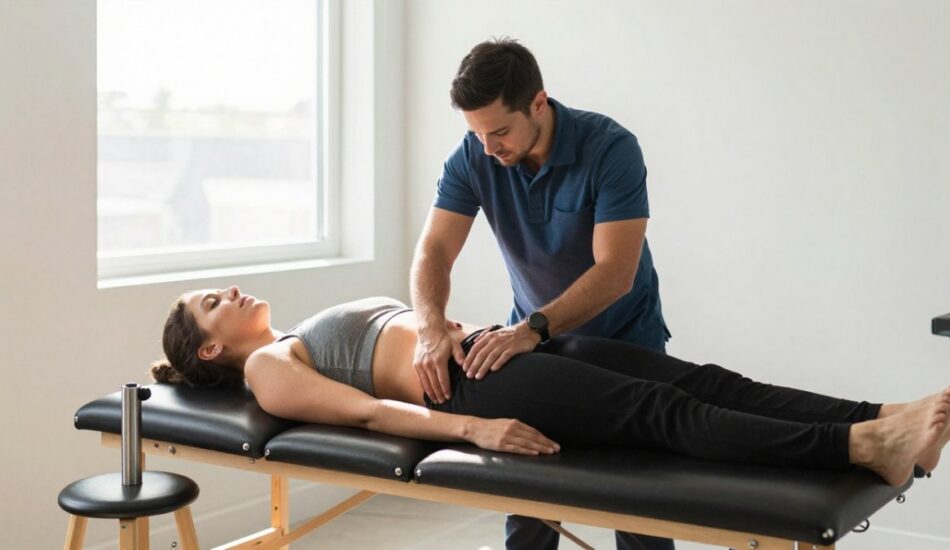
Chiropractic care focuses on the spine and joints. Chiropractic care generally focuses on the spine and joints and may include manual adjustments, soft-tissue techniques and exercise guidance. The useful question is how it fits your specific injury after a collision.
What a chiropractor actually does in this context
- History and examination. A chiropractor should take a detailed crash history (direction of impact, speed, seatbelt use, head position), then check posture, spinal motion, muscle tone and nerve function. Most practitioners will not adjust a new patient on the first visit until they have ruled out red flags.
- Manual adjustment. Controlled, directed force to a joint to improve motion and reduce muscle guarding. The audible “pop” is gas releasing in the joint, not a sign that something was fixed.
- Soft-tissue work. Hands-on techniques, instrument-assisted methods or stretching aimed at strained muscles and ligaments, which are common after a sudden jolt.
- Exercise and movement guidance. Home exercises and activity advice to keep the spine moving between visits, which matters because prolonged rest can slow recovery.
What the evidence can and cannot tell you
In a retrospective review of motor-vehicle-accident patients from one chiropractic practice, patients averaged 14.2 treatments, and 40.2% needed ongoing care for persistent pain S. Dies, “Chiropractic treatment of patients in motor vehicle accidents,” PubMed Central. That review reflects one practice, so it is not a benchmark for every patient. A single case report can describe improvement in one patient, but it cannot show what will happen to you Case report describing conservative care for a car-crash-injured patient.
Results vary, and chiropractic care is not a guarantee. It does not repair fractures or nerve damage, and outcomes depend on injury type, age, overall health and how consistently you follow your care plan. Ask a qualified provider what to expect in your situation, and ask what would make them stop or change course.
Medical evaluation comes first to rule out fracture, nerve injury or internal injury. Coordinate your care so each provider knows what the others are doing, share imaging results, medication changes and any new symptoms. (Source: National Center for Complementary and Integrative Health)
Watch out: If a provider promises a fixed number of visits, guarantees a full recovery, or discourages you from seeing a doctor, treat that as a reason to get a second opinion. Legitimate care is paced to your response, not to a sales target.
Ask a qualified provider what to expect in your situation.
Car Accident Back Pain Treatment Options Beyond Chiropractic Care
Other treatment options may fit better depending on your injury. A doctor should guide the mix of treatments, and you should coordinate your care so each provider knows what the others are doing.
Exercises for Back Pain After a Car Accident
Gentle movement often helps back pain recover. Start slowly and stop if an exercise causes sharp or worsening pain. The goal in the first weeks is not fitness, it is keeping the spine and surrounding muscles moving without provoking the injury.
A patient doing gentle stretches on a mat in a bright clinic room can be a useful starting point.

The patient is American.
A practical progression
Most practitioners structure exercise in stages rather than one flat list. A common pattern:
- Early stage (first days to couple of weeks). Gentle range-of-motion work and short walks. The aim is to reduce stiffness and avoid deconditioning, not to stretch into pain.
- Middle stage. Add light strengthening for the core and postural muscles, plus controlled mobility drills, once pain is stable and not worsening.
- Later stage. Progress load and add functional movements (bending, lifting, sitting tolerance) as symptoms allow, ideally with guidance from your chiropractor or physical therapist.
If you notice sharp pain, pain that radiates into the arms or legs, new numbness or weakness, or soreness that worsens over the next day, stop and get reassessed.
Watch out: If an exercise causes numbness, tingling or weakness in a limb, stop and contact a clinician, those symptoms can indicate nerve involvement that exercise alone will not fix.
Keep a simple note of your symptoms and activities, and bring it to your next visit.
Chiropractic Recovery Timeline After a Car Accident and Next Steps
Recovery time depends on the injury, your health and how consistently you follow care, and it varies widely from person to person.
Keep a simple record of your symptoms, appointments and missed work. This helps you and your providers track progress, and it can matter if you later pursue a claim. Learn how to document chronic pain for a personal injury lawsuit.
If the pain continues or your daily life is affected, talk with a lawyer about your options. Contact a Augusta neck and back injury lawyer for a free consultation.
At Merritt & Merritt Law Firm, our team has over 50 years of trial experience. Our attorneys can visit clients at home, in the office or in the hospital, and you pay only if we win. Schedule a Free Consultation to discuss your situation.
Recovery time depends on the injury, your health and how consistently you follow care, so the details below are worth tracking.
Item | Value | Note |
|---|---|---|
Average chiropractic treatments (MVA review) | 14.2 | One practice’s retrospective review |
Patients needing ongoing care for persistent pain | 40.2% | Same review, one practice only |
Typical exercise stages | 3 | Early, middle and later stages |
Early-stage duration | First days to a couple of weeks | Gentle range-of-motion work and short walks |
Frequently Asked Questions
Is a chiropractor good after a car accident?
A chiropractor can be one part of care after a car accident, particularly for neck and back pain involving the spine and muscles. Research on chiropractic care after collisions is limited, mostly consisting of individual case reports and a retrospective review of one practice’s files, so those results cannot be generalized to every patient. Because some injuries, such as fractures, nerve damage or internal injuries, need prompt medical evaluation, see a physician first. A chiropractor can then help coordinate care, and your doctor can confirm whether chiropractic treatment fits your condition.
What exercises can I do to relieve back pain after a car accident?
Gentle movement is often recommended early on, but the right exercises depend on your injury, so check with your doctor or physical therapist before starting a program. Short walks, gentle pelvic tilts, and slow range-of-motion movements within a pain-free range are commonly discussed options. Stop any movement that causes sharp, shooting or worsening pain, numbness or tingling. Consistency matters more than intensity, so brief sessions done daily are usually safer than long workouts.
How long does back pain take to improve after a car accident?
Recovery time varies widely depending on the severity of the injury, your overall health, and how quickly you begin treatment. Some people notice improvement within weeks, while soft-tissue injuries or disc-related problems can take months. Published case reports describe improvement in individual patients, but they do not establish a typical timeline for everyone. Keep your medical providers informed about your symptoms, and ask them to explain what recovery may look like for your specific injury.
Can I get compensation for lower back pain after a car accident?
Injured people in Georgia and Florida may be able to pursue compensation for medical bills, lost wages and pain and suffering, depending on the facts of the crash and applicable state law. Keeping records of treatment, appointments and missed work helps document the injury. Speaking with a personal injury attorney can help you understand your options and how insurance claims work. Merritt & Merritt Law Firm offers free consultations, and you pay only if the firm wins your case.

Our Locations

Atlanta/Decatur
1 West Court Square
Suite 750
Decatur, GA 30030

Savannah
100 Bull Street
Suite 200
Savannah, GA 31401

Statesboro
15 West Main Street
Statesboro, GA 30458

Houston
1415 Louisiana Street,
Suite 1800,
Houston, TX 77002

Jacksonville
841 Prudential Drive
12th Floor
Jacksonville, FL 32207

Contact Us
© Copyright 2026 Merritt & Merritt Law Firm. All rights reserved.