
call us 24/7 1-800-738-WE-WIN
call us 24/7 1-800-738-WE-WIN
Serving All of Georgia, Florida, & Texas
How to Prove Negligence in Apartment Security Cases
Table of Contents
- Understanding Negligent Security and Your Right to Recovery
- The Four Elements of a Negligent Security Claim Explained
- Proving Foreseeability in Negligent Security Cases
- Critical Evidence for Negligent Security Cases
- Common Examples of Inadequate Security in Apartment Complexes
- Step-by-Step Evidence Preservation and Collection
- How Insurance Companies Challenge Negligence Claims
- Filing Your Negligence Claim: Timeline and Legal Deadlines
Last Updated: July 27, 2026
Understanding Negligent Security and Your Right to Recovery
Call the Merritt & Merritt Law Firm today at 404-975-1775.
When someone is injured due to inadequate security at an apartment complex, the property owner may be liable for damages. Property owners have a duty to protect residents and visitors from reasonably foreseeable criminal acts. When they fail to implement reasonable security measures, broken locks, missing cameras, inadequate lighting, or no security personnel, and someone is harmed, that failure can form the basis of a personal injury lawsuit.
What Constitutes Negligent Security
Negligent security occurs when a property owner fails to implement reasonable protective measures that would prevent foreseeable criminal acts. Courts don’t expect perfection, but they do expect property owners to respond appropriately to known risks. Common examples include failing to install working locks on exterior doors, not maintaining adequate outdoor lighting in parking areas, neglecting to repair broken security cameras, or failing to hire security personnel when prior criminal activity suggests it’s necessary. Foreseeability drives the analysis.
Why Apartment Complexes Have a Duty of Care
Property owners, including apartment complex managers and owners, owe a legal duty of care to residents and visitors because they control the premises and benefit financially from renting units. This duty includes protecting against criminal acts that are reasonably foreseeable based on location, prior incidents, and industry standards.
The Four Elements of a Negligent Security Claim Explained
Every negligent security claim rests on four legal elements. All four must be proven to win your case.
Duty of Care: What Property Owners Must Provide
Property owners owe a duty to residents, tenants, and invited guests to maintain reasonably safe premises. A residential apartment complex must maintain common areas, entrances, parking lots, and hallways in a reasonably safe condition, including implementing security measures appropriate to the location and known risks. Courts evaluate duty based on what a reasonable property owner would do in similar circumstances.
Breach of Duty: Failing to Implement Reasonable Security Measures
You must prove the property owner breached its duty by failing to take reasonable steps to prevent the criminal act that injured you. Common breaches include broken locks that weren’t repaired, exterior doors that don’t lock properly, non-functional security cameras, missing or inadequate outdoor lighting, lack of security personnel despite prior criminal activity, and failure to respond to tenant complaints about security hazards.
Causation: Linking the Breach to Your Injury
You must prove that the security failure directly caused your injury. This requires showing that the criminal act wouldn’t have occurred, or would have been prevented, if the property owner had implemented reasonable security. If you were assaulted in a dark parking lot with broken outdoor lighting, you’d argue that adequate lighting would have deterred the attacker or allowed you to see danger approaching. Evidence supporting causation includes expert testimony about how the security failure enabled the crime, police reports documenting how the perpetrator gained access, and witness statements about what happened.
Damages: Quantifying Your Losses
The final element requires proving you suffered actual damages, including medical expenses, lost wages, pain and suffering, and permanent injury or disability. Document all medical treatment related to the incident. Keep records of emergency room visits, hospital stays, physical therapy, medication, and ongoing treatment. For lost wages, gather pay stubs, tax returns, and employer statements showing income you lost while recovering. Pain and suffering damages compensate you for physical pain, emotional trauma, anxiety, sleep disruption, and reduced quality of life.
Proving Foreseeability in Negligent Security Cases
Foreseeability is the linchpin of negligent security law. A property owner isn’t required to prevent every possible crime, only crimes that are reasonably foreseeable based on circumstances.
Prior Criminal Activity and Pattern Evidence
The strongest evidence of foreseeability is prior criminal activity at the same location. If the apartment complex experienced previous break-ins, assaults, or other crimes, those incidents put the property owner on notice that security improvements were necessary. Obtain police reports documenting crimes at the complex. Request incident reports from the property management company. Speak with other residents who experienced crimes. Compile a timeline showing when crimes occurred and what security measures existed at each time.
How Courts Evaluate Reasonable Foreseeability
Courts don’t require that the exact same crime happen again. They ask whether similar crimes in the area or at the property made criminal activity foreseeable. Relevant factors courts consider include the crime rate in the neighborhood, prior incidents at the specific property, complaints from residents about security, industry standards for similar properties, and security measures at comparable complexes in the area.
Critical Evidence for Negligent Security Cases
Building a winning negligent security claim requires assembling multiple types of evidence.
Police Reports and Official Documentation
Police reports are foundational evidence. They document what happened, how the crime occurred, and what conditions enabled it. Request the police report immediately after the incident. Beyond your own incident, obtain police reports for prior crimes at the complex. These establish the pattern of criminal activity that makes your incident foreseeable.
Security Logs and Digital Evidence
Security logs document who accessed the building, when, and how. Request these records immediately. Email communications between residents and property management about security concerns are powerful evidence of knowledge and inaction. Send a preservation letter requesting that all relevant digital records be maintained pending litigation.
Surveillance Footage and Camera Records
Video surveillance footage shows exactly how the crime occurred and what security failures enabled it. Request all surveillance footage from the date and time of the incident immediately, most security systems record over old footage after 30-90 days. If cameras existed but weren’t recording, that’s evidence of negligence.
Witness Testimony and Statements
Eyewitnesses who saw the crime, the perpetrator, or the conditions that enabled it provide crucial testimony. Collect written statements from witnesses as soon as possible while memories are fresh. Other residents who experienced prior crimes or complained about security are valuable witnesses. Expert witnesses, such as security experts, can testify about industry standards for apartment complexes and how the property’s security fell short.
Common Examples of Inadequate Security in Apartment Complexes
Physical Security Failures
Broken or non-functioning locks on exterior doors, inadequate outdoor lighting in parking lots and walkways, non-functional security cameras, broken windows, damaged fences, and missing or broken intercoms all constitute common failures.
Staffing and Personnel Gaps
Lack of security personnel in high-crime areas or after documented incidents is a significant failure. Insufficient staff to monitor common areas, respond to emergencies, or investigate suspicious activity constitutes inadequate staffing.
Maintenance and Access Control Issues
Delayed repairs to broken locks, damaged doors, or non-functional security equipment extend the period during which the property is vulnerable. Failure to implement access control systems, such as key cards, digital locks, or gate systems, in complexes where such systems are standard in the area represents inadequate security.
Step-by-Step Evidence Preservation and Collection
The period immediately after the incident is critical. Evidence disappears, memories fade, and opportunities to preserve crucial information slip away.
Immediate Actions After the Incident
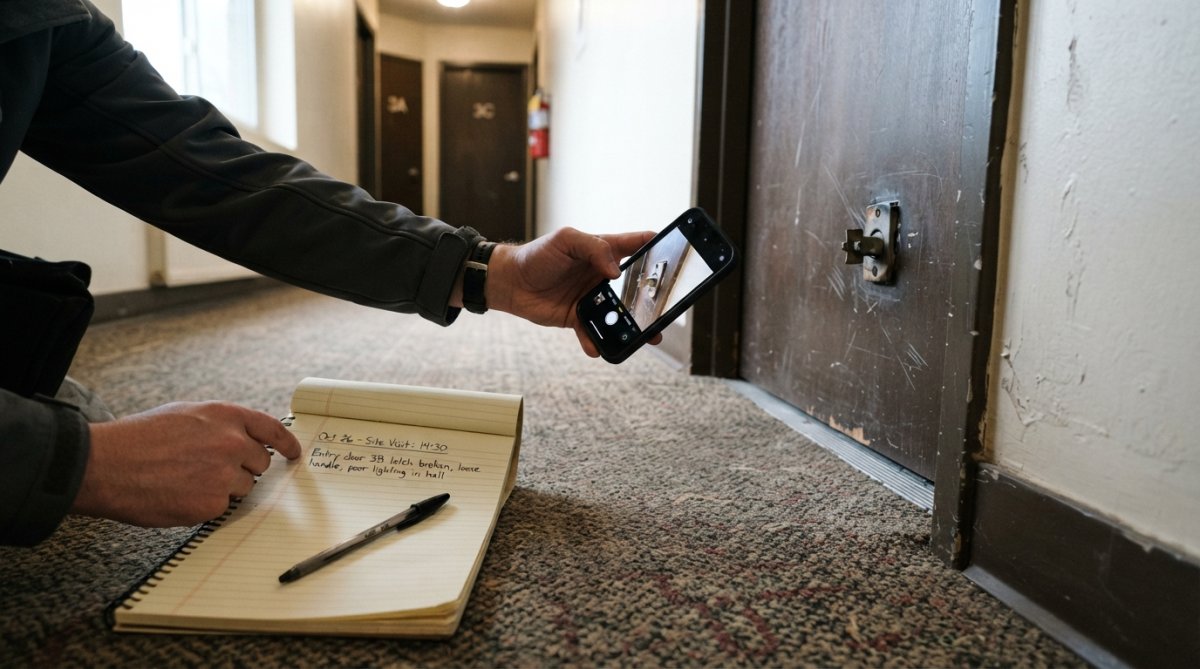
Call police and report the crime. Request a police report number and obtain the officer’s name and badge number. Photograph and document the scene immediately, showing lighting conditions, security equipment, entry points, and any visible damage. Photograph visible injuries and obtain medical evaluation and treatment records. Identify and collect contact information from all witnesses. Notify the property management company in writing about the incident and request preservation of all relevant evidence, specifically security footage, access logs, maintenance records, and incident reports.
Documentation Checklist for Your Claim
Documentation Type | Action | Timeline |
|---|---|---|
Police report | Obtain full report with incident number | Within 1 week |
Medical records | Collect all treatment, diagnoses, prognosis | Ongoing |
Photographs | Scene, injuries, security failures, lighting | Within 48 hours |
Witness statements | Written statements from all witnesses | Within 1 week |
Security footage | Request preservation and copies | Immediately |
Access logs | Request digital entry records | Immediately |
Maintenance records | Request repair history for locks, cameras, lighting | Within 2 weeks |
Prior incident reports | Obtain police reports for prior crimes at complex | Within 3 weeks |
Lease and rules | Obtain your lease and complex security policies | Within 1 week |
Resident complaints | Document complaints you or others made about security | Within 2 weeks |
Expert evaluations | Hire security expert to assess property | Within 4 weeks |
Insurance information | Obtain property owner’s liability insurance details | Within 2 weeks |
Preserving Digital Records Before They Disappear
Send a formal preservation letter to the property management company immediately after the incident. This letter requests that all relevant digital records, security footage, access logs, email communications, and maintenance records be preserved and not deleted or overwritten. A preservation letter creates legal obligation. Request copies of security footage on an external drive or USB device and digital access logs showing who entered and exited the building, when doors were locked or unlocked, and any system failures.
How Insurance Companies Challenge Negligence Claims
Insurance companies representing property owners employ sophisticated strategies to minimize or deny negligence claims.
Common Defense Tactics and How to Counter Them
Insurance adjusters will argue that the criminal act was unforeseeable, even if prior crimes occurred at the property. Counter this by showing patterns of criminal activity regardless of type. They’ll argue that the property owner’s security measures met industry standards and were reasonable. Counter by obtaining evidence of what comparable apartment complexes in your area actually implement. They’ll claim the property owner had no notice of the problem. If prior crimes occurred, police reports prove notice. If residents complained about security issues, those complaints create notice.
Tenant Rights vs. Lease Agreement Language
Some leases contain language attempting to limit the property owner’s liability or shift responsibility for security to tenants. Such clauses are often unenforceable. Courts recognize that property owners cannot contract away their basic duty of care to maintain reasonably safe premises. Review your lease carefully. If the lease required the property owner to maintain certain security measures and they failed to do so, that breach is clear negligence.
Filing Your Negligence Claim: Timeline and Legal Deadlines
Understanding the timeline for filing your claim is critical. Missing deadlines can bar your case entirely.
Understanding Statute of Limitations
The statute of limitations is the deadline for filing a lawsuit. In most states, the statute of limitations for personal injury cases is two to three years from the date of injury. However, some states have different periods for premises liability claims. Research your specific state’s statute of limitations. Don’t wait until the last minute to file. Evidence degrades, witnesses move away, and memories fade.
When to File Before Critical Evidence Disappears
Contact an attorney within days of the incident, not weeks or months. Early intervention ensures evidence is preserved, witnesses are identified, and your claim is filed within all applicable deadlines.
Frequently Asked Questions
What are the four elements of negligence in a premises liability case?
To prove negligence in apartment security cases, you must establish four elements: (1) the property owner had a duty of care toward you, (2) they breached that duty by failing to maintain reasonable security measures, (3) their breach directly caused your injury or damages, and (4) you suffered actual damages such as medical expenses or lost wages. Each element must be proven with evidence like police reports, security logs, and witness testimony to succeed in your claim.
What evidence is most important for a negligent security case?
Critical evidence includes police reports documenting the criminal act, security logs showing gaps in monitoring, surveillance camera footage if available, witness statements, prior incident reports at the property, and documentation of inadequate security features like broken locks or missing lighting. Digital evidence preservation is essential—request security footage immediately, as it may be automatically deleted after 30-90 days. Medical records linking your injuries to the incident also strengthen your claim significantly.
How do I prove foreseeability in a negligent security case?
Foreseeability is proven by demonstrating prior criminal activity at the apartment complex or nearby properties. Gather police reports of previous crimes, incident reports from building management, and testimony from other residents about security concerns. Courts evaluate whether a reasonable property owner should have anticipated criminal acts based on the location's crime history. If the complex had previous break-ins, assaults, or robberies, this establishes that criminal acts were foreseeable and the owner should have enhanced security measures.
What should I do immediately after a security-related incident to protect my claim?
First, ensure your safety and seek medical attention if needed. Document everything: photograph the scene, broken locks, inadequate lighting, or other security failures. Get written statements from witnesses immediately. File a police report and obtain the report number. Request security footage preservation from management in writing—do this within 24 hours. Preserve all communications with the property management. Avoid signing anything the insurance company sends without legal review. Contact an attorney promptly, as statute of limitations deadlines can affect your ability to recover damages.
Our Locations

Atlanta/Decatur
1 West Court Square
Suite 750
Decatur, GA 30030

Savannah
100 Bull Street
Suite 200
Savannah, GA 31401
Statesboro
15 West Main Street
Statesboro, GA 30458
Houston
1415 Louisiana Street,
Suite 1800,
Houston, TX 77002

Jacksonville
841 Prudential Drive
12th Floor
Jacksonville, FL 32207

Contact Us
© Copyright 2026 Merritt & Merritt Law Firm. All rights reserved.