
call us 24/7 1-800-738-WE-WIN
call us 24/7 1-800-738-WE-WIN
Serving All of Georgia, Florida, & Texas
How to Prove Fault Without a Police Report
Table of Contents
- Can You File a Claim Without a Police Report?
- Why Documentation Matters When There’s No Official Report
- Building Your Car Accident Evidence Checklist
- Collecting a Witness Statement Template for Car Accidents
- How Long Do You Have to Report a Car Accident to Insurance?
- Proving Liability Through Comparative Negligence Analysis
- Negotiating Your Claim Without a Police Report
- What to Do If the Insurance Adjuster Denies Your Claim
Last Updated: August 7, 2026
Can You File a Claim Without a Police Report?
Yes, you can file an insurance claim without a police report. Many accident victims assume one is mandatory, but insurance companies will process claims based on the evidence you provide. Without an official police report, you’ll need to build a stronger case through documentation, witness statements, and photographic evidence.
A police report carries weight as an official law enforcement record. Without one, the burden shifts to you to demonstrate what happened and who was at fault. According to the National Highway Traffic Safety Administration’s guidance on accident documentation, proper evidence collection is critical when official reports are unavailable.
Call the Merritt & Merritt Law Firm today at 404-975-1775.
Why Documentation Matters When There’s No Official Report
Documentation becomes your official record when police never created one. Insurance adjusters rely on evidence to determine liability, and without a police report, they’re evaluating your photos, witness statements, medical records, and your account of what happened.
Think of your documentation as the foundation of your claim. A strong foundation means the insurance company has clear evidence to work with. Insurance adjusters are trained to look for inconsistencies. If your written account conflicts with your photos, or if witness statements contradict each other, adjusters will use those gaps to reduce your settlement or deny your claim.
Building Your Car Accident Evidence Checklist
A car accident evidence checklist ensures you capture everything an insurance adjuster needs to see. The most common mistake is waiting too long to gather evidence. Memories fade, witnesses become harder to locate, and physical evidence at the scene disappears.
Start documenting immediately after the accident, assuming it’s safe to do so. Within the first 24-48 hours, begin collecting the evidence below.
Photographic and Video Evidence
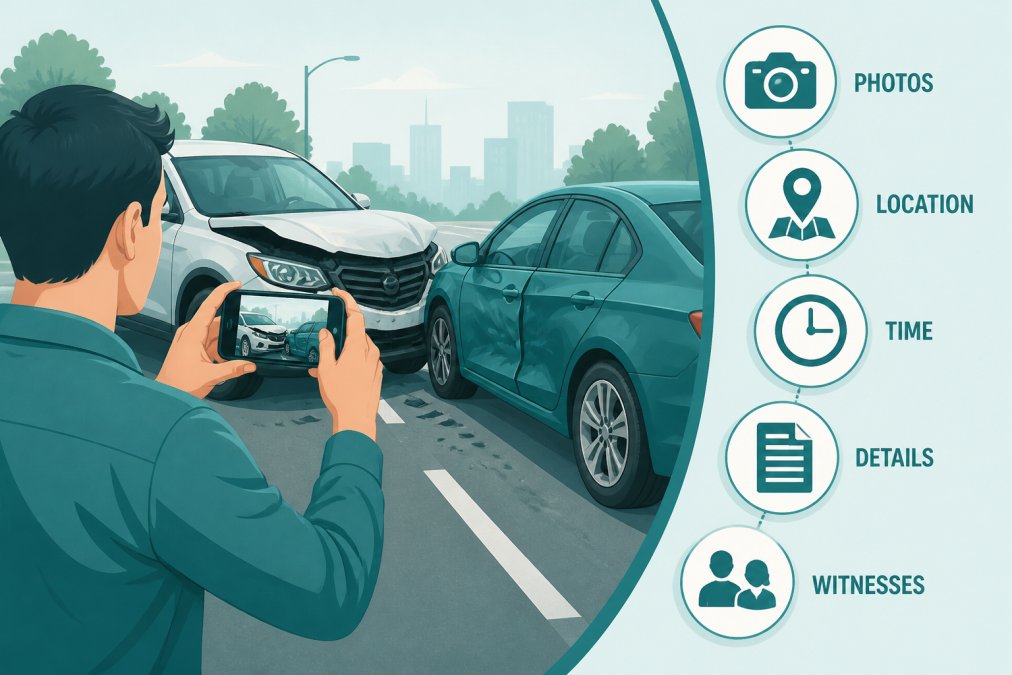
Photographs are your strongest visual proof. Take photos of vehicle damage from multiple angles, front, back, sides, and close-ups of the most severe damage. Photograph the accident scene: road conditions, traffic signals, lane markings, and any skid marks. Include wide shots showing the relative positions of both vehicles.
Video evidence is even more powerful. Record a walking video tour of the scene and narrate what you’re seeing: “This is the intersection where the accident occurred. The traffic light is red in this direction. Here’s the damage to my vehicle on the driver’s side.” This narration adds context that photos alone cannot provide.
Photograph any visible injuries within the first few days. These photos document your injuries at the time of the accident, which matters for your claim.
Digital Evidence Preservation
Digital evidence includes text messages, emails, phone records, and location data. If you texted or called anyone immediately after the accident, preserve those messages. They establish when the accident occurred and what you reported at the time.
Preserve your phone’s location data if available. Screenshot your location history if your phone has this feature enabled. Save any dash cam footage if your vehicle has one. Email yourself copies of all photos and videos immediately to create a digital timestamp and backup copies.
Collecting a Witness Statement Template for Car Accidents
Witness statements are critical when there’s no police report. A witness is someone who saw the accident happen, not someone who arrived afterward or heard about it secondhand. The best witnesses are neutral third parties with no connection to either driver.
Approach potential witnesses at the scene while they’re still present. Exchange contact information before they leave: full name, phone number, email address, and home address. Ask if they’re willing to provide a written or recorded statement.
A witness statement should include:
- Witness’s full name, contact information, and relationship to either driver (if any)
- Where the witness was located when the accident occurred
- What they saw happen, in chronological order
- Which driver they believe was at fault and why
- Any traffic signals, road signs, or weather conditions they noticed
Here’s a template you can use:
Witness Statement for Car Accident
I, [Witness Name], was present at [Location] on [Date] at approximately [Time]. I was [describe what you were doing, walking, driving, waiting at a bus stop, etc.].
I witnessed an accident involving two vehicles. The [color/make/model] vehicle driven by [driver name, if known] was traveling [direction] on [street name]. The [color/make/model] vehicle driven by [driver name, if known] was traveling [direction] on [street name].
The accident occurred when [describe exactly what happened, which vehicle moved into the other’s path, which vehicle had the green light, etc.]. I believe the driver of the [color/make] vehicle was at fault because [explain why, they ran a red light, didn’t yield, was speeding, etc.].
The weather conditions were [clear/rainy/foggy, etc.]. The road surface was [dry/wet/icy, etc.]. I did not see any mechanical problems with either vehicle before the accident.
I am willing to provide additional information if needed. You can reach me at [phone] or [email].
Schedule a Free Consultation →
Signature: ________________ Date: ________________
Ask the witness to sign and date the statement. If they’re uncomfortable writing it themselves, you can write it based on their account and have them sign it. If they’re willing, record a video statement on your phone where they describe what they saw. Follow up with witnesses within 24 hours if you haven’t collected a formal statement.
How Long Do You Have to Report a Car Accident to Insurance?
Most insurance policies require you to report an accident as soon as possible, typically within 24-48 hours. Check your specific policy for the exact timeline. Delaying your report can give the insurance company grounds to deny your claim.
Call your insurance company the same day if the accident happened during business hours. If the accident occurred at night or on a weekend, call first thing the next business day. If you’re hospitalized or severely injured, notify your insurance company as soon as you’re able and explain the circumstances for any delay.
When you call, provide basic information: the date, time, and location of the accident; the names and contact information of the other driver and any witnesses; and a brief description of what happened. Don’t admit fault or speculate about what caused the accident.
Report the accident to your own insurance company even if you weren’t at fault.
Proving Liability Through Comparative Negligence Analysis
Comparative negligence is a legal concept that determines how much fault each driver bears for the accident. In comparative negligence states, you can recover damages even if you were partially at fault. However, your recovery is reduced by your percentage of fault. For example, if you were 20% at fault and your damages total $10,000, you can recover $8,000.
Georgia and Florida both follow comparative negligence rules. To counter the insurance company’s attempts to assign you fault, build evidence that clearly shows the other driver was at fault. Look for traffic violations: running a red light, failing to yield, speeding, or unsafe lane changes. Document road conditions, visibility, and any statements the other driver made at the scene.
If the other driver admitted fault (“I didn’t see you” or “I wasn’t paying attention”), include this in your account. Inconsistencies in their story suggest they’re being untruthful.
Negotiating Your Claim Without a Police Report
Negotiating without a police report requires you to present your evidence clearly and confidently. Start by submitting a demand letter that summarizes your case, lists your damages, and requests a specific settlement amount. Include copies of your evidence: photos, witness statements, medical records, repair estimates, and any other documentation.
Be specific about your damages. List your medical bills, lost wages, property damage, and pain and suffering. Provide receipts and documentation for each expense. The insurance adjuster will likely make a low initial offer. Counter with evidence that supports a higher amount.
Stay professional throughout negotiations. Let your evidence do the talking. If the insurance company continues to lowball you, consider hiring an attorney. Many personal injury attorneys work on contingency: you pay nothing unless they win your case.
What to Do If the Insurance Adjuster Denies Your Claim
A claim denial without a police report is often based on the argument that there’s insufficient evidence to determine fault. Respond to the denial with a detailed letter explaining why your documentation is sufficient. Reference your photos, witness statements, medical records, and any other evidence. Request a detailed explanation of why the insurance company denied your claim.
If the insurance company still refuses to pay, you can file a complaint with your state’s insurance commissioner, request an appraisal or arbitration, or hire an attorney. According to [the American Bar Association’s guidance on personal injury(/blog/best-personal-injury-attorney-georgia/) claims | americanbar.org], many denied claims are successfully appealed when an attorney presents additional evidence or challenges the insurer’s reasoning.
Merritt & Merritt Law Firm has successfully recovered compensation for clients whose claims were initially denied. Our team investigates the accident, gathers additional evidence, and negotiates aggressively with insurance companies. We offer 24-hour service and can visit you at home, your office, or the hospital. You only pay if we win.
Proving fault without a police report is challenging but absolutely possible. The strength of your documentation determines your success. Gather photos, videos, witness statements, and medical records immediately after the accident. Present this evidence clearly to your insurance company and be prepared to negotiate. If the insurance company denies your claim, Merritt & Merritt Law Firm can investigate further and pursue the compensation you deserve. With over 45 years of trial experience and 24-hour availability, we’re ready to fight for you. Schedule a free consultation today to discuss your case with an experienced attorney.
Frequently Asked Questions
Can you file a car accident claim without a police report?
Yes, you can file a claim without a police report, but it's more challenging. Insurance companies and at-fault parties are more likely to dispute liability when there's no official record. You'll need strong alternative documentation: witness statements, photographs, medical records, and your own detailed account of events. First-party claims (with your own insurer) are easier to pursue without a report than third-party claims (against the other driver). However, having a police report significantly strengthens your position by providing an official, neutral documentation of the accident scene and initial facts.
How long do you have to report a car accident to insurance?
Most insurance policies require you to report an accident as soon as possible, typically within 24 to 72 hours. Some policies specify immediate notification. Delays can give insurers grounds to deny your claim, especially if they argue the delay prevented them from investigating properly. Check your specific insurance policy for exact timelines. If you're injured and unable to report immediately, contact your insurer as soon as you're able and explain the circumstances. Documenting when you report the accident protects you from later disputes about timing.
What evidence is most important when proving fault without a police report?
Witness testimony is your strongest substitute for a police report. Get written or recorded statements from anyone who saw the accident, including their contact information and what they observed about how the collision occurred. Photographs of vehicle damage, road conditions, traffic signals, and the accident scene are equally critical—they create a visual timeline of events. Medical records documenting injuries sustained at the time of the accident support your credibility. Your own detailed written account, created as soon as possible after the accident, plus any dashcam or surveillance footage, rounds out a compelling case. Insurance adjusters weigh witness corroboration heavily when there's no official report.
Does not having a police report automatically make me at fault?
No. Liability is determined by evidence of negligence, not by the presence or absence of a police report. A missing report simply means you must work harder to gather and present that evidence. Insurance adjusters and courts examine traffic laws, driver statements, witness testimony, physical evidence, and accident reconstruction to determine fault. Comparative negligence laws in Georgia and Florida allow for shared responsibility—you can recover compensation even if you bear some responsibility, as long as you're not the primary at-fault party. Without a report, your documentation and witness statements become your primary tools for proving the other driver's negligence.
Our Locations

Atlanta/Decatur
1 West Court Square
Suite 750
Decatur, GA 30030

Savannah
100 Bull Street
Suite 200
Savannah, GA 31401
Statesboro
15 West Main Street
Statesboro, GA 30458
Houston
1415 Louisiana Street,
Suite 1800,
Houston, TX 77002

Jacksonville
841 Prudential Drive
12th Floor
Jacksonville, FL 32207

Contact Us
© Copyright 2026 Merritt & Merritt Law Firm. All rights reserved.