
call us 24/7 1-800-738-WE-WIN
call us 24/7 1-800-738-WE-WIN
Serving All of Georgia, Florida, & Texas
How to File a Car Accident Claim: Step-by-Step Guide

Table of Contents
- Immediate Steps at the Accident Scene
- How to Document Your Car Accident for Insurance
- Seek Medical Attention and Document Your Injuries
- Report the Accident to Police and File Your Claim
- What to Say to Your Insurance Adjuster After an Accident
- Understanding the Car Insurance Claim Settlement Timeline
- How to File a Car Accident Claim: Common Mistakes to Avoid
- Conclusion
Last Updated: August 8, 2026
Immediate Steps at the Accident Scene
The first few minutes after a car accident determine how much evidence you’ll have and how strong your claim becomes. Your immediate priority is safety, then documentation.
Call the Merritt & Merritt Law Firm today at 404-975-1775.
Check for injuries first. If anyone is hurt, call 911 immediately. If the scene is unsafe due to heavy traffic or hazardous conditions, move to a safe location if possible. Turn on hazard lights and keep a safe distance from traffic.
Once everyone is safe, exchange information with the other driver: name, phone number, address, driver’s license number, license plate, vehicle make and model, and insurance details. Don’t admit fault or apologize, stick to facts. Get witness contact information immediately, as people often leave accident scenes.
Take photos of the accident scene from multiple angles: vehicle damage, road conditions, traffic signals, street signs, skid marks, and the overall scene. These images become evidence for your insurance claim and any potential legal action.
Call the police non-emergency line to report the accident. In most states, accidents involving injury or significant property damage require a police report. Get the officer’s name and badge number, and ask when the report will be available.
How to Document Your Car Accident for Insurance
Documentation transforms a “he said, she said” situation into evidence. The stronger your documentation, the faster your claim moves and the better your settlement.
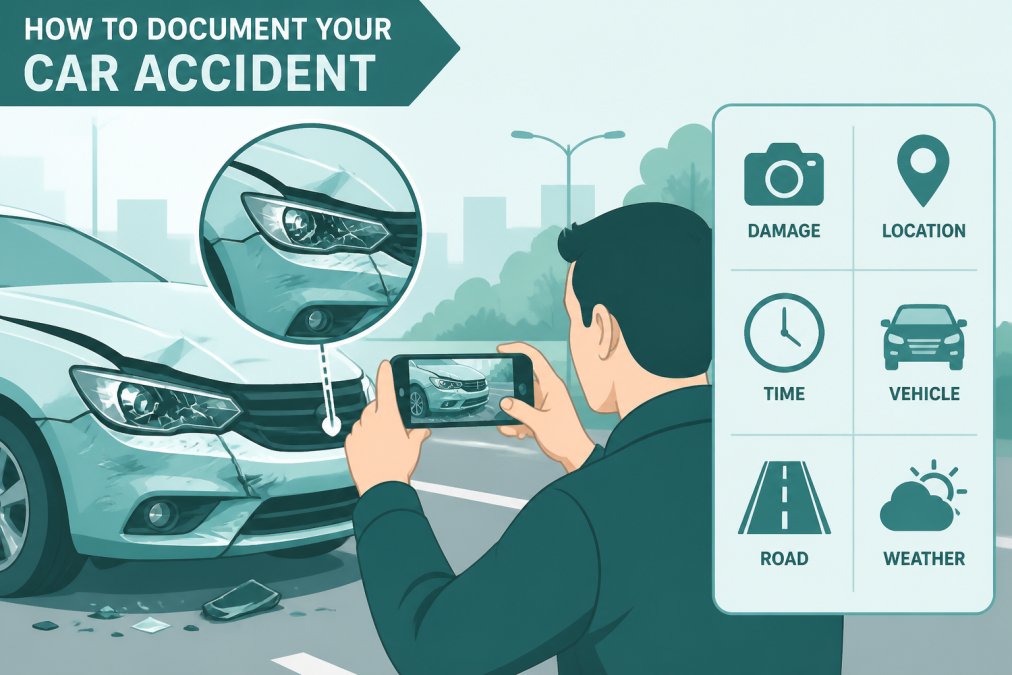
(/georgia-car-accident-lawyer/) for Insurance]
Take comprehensive photos immediately from multiple angles: front, back, sides, and interior. Include close-ups of specific damage and wide shots showing the overall scene. Photograph weather conditions if relevant. Most smartphones automatically timestamp photos.
Collect the police report once filed. Request a copy from the police department or download it online, you’ll need this for your insurance claim and any legal proceedings.
Document your injuries with medical records. Photograph visible injuries on the day of the accident and for several days after. Keep records of every medical visit, treatment, and prescription.
Keep detailed records of all accident-related expenses: car repairs, rental vehicles, medical treatment, medications, and travel to appointments. Track lost wages if you missed work due to injury.
Write down your account of the accident while it’s fresh, including the date, time, location, road conditions, traffic signals, vehicle positions, and how the collision occurred. This written statement becomes your reference point if your memory becomes hazy later.
Seek Medical Attention and Document Your Injuries
Many accident victims delay medical care because they feel “okay” immediately after the accident. Adrenaline masks pain and injury. Seeking immediate medical attention protects your health and strengthens your claim.
Go to an emergency room, urgent care clinic, or your primary care physician within 24 hours of the accident. Report all symptoms: neck pain, back pain, headaches, dizziness, numbness, anxiety, or sleep problems. Even minor symptoms should be documented.
Follow your doctor’s treatment recommendations completely. If your doctor prescribes physical therapy, pain management, or follow-up visits, complete all recommended treatment. Insurance adjusters scrutinize gaps in medical care.
Document how the accident affects your daily life. Keep a journal describing your symptoms, pain levels, limitations on work and activities, sleep disruption, and emotional impact.
Request copies of all medical records, imaging results, and treatment notes. Your attorney needs complete medical documentation to evaluate your claim and negotiate with the insurance company.
Report the Accident to Police and File Your Claim
Filing a police report creates an official record of the accident. In most states, accidents involving injury or significant property damage are legally required to be reported to police.
Call the police non-emergency line (not 911 unless there’s immediate danger or serious injury). Provide your location, the number of vehicles involved, whether anyone is injured, and whether the scene is safe.
When the officer arrives, provide factual information about the accident. Describe what happened, the other vehicle’s position, traffic signals, and road conditions. Stick to facts and don’t speculate about fault.
Get the police report number before the officer leaves. You’ll need this number to obtain a copy of the report and reference it in your insurance claim.
File your insurance claim as soon as possible. Contact your insurance company by phone or through their website. Provide your policy number, the accident date and location, and the other driver’s insurance information.
Notify your insurance company of any injuries, even if you don’t think they’re serious. Early notification creates a record that protects your claim later.
What to Say to Your Insurance Adjuster After an Accident
Your insurance adjuster investigates your claim and determines what your insurance company will pay. What you say to the adjuster directly affects your settlement.

Stick to facts when describing the accident. Describe the date, time, location, weather, road conditions, traffic signals, vehicle positions, and how the collision occurred. Avoid opinions or speculation about fault.
Report all injuries, even minor ones. Tell the adjuster about every symptom you experienced. Document these statements in writing by following up with an email summarizing your conversation.
Provide complete medical documentation promptly. Delays in responding suggest you’re hiding something.
Schedule a Free Consultation →
Don’t accept the first settlement offer. Insurance companies typically offer less than your claim is worth initially. Ask the adjuster to explain how they calculated the offer and request an itemized breakdown.
Avoid discussing settlement details on the phone. Request written communication from the adjuster. Email creates a record of what was discussed.
Never sign a release form without understanding what you’re signing. A release form requires you to accept a settlement amount and waive your right to pursue further claims. Have an attorney review any settlement documents before signing.
Understanding the Car Insurance Claim Settlement Timeline
The car insurance claim settlement timeline varies based on claim complexity, injury severity, and how quickly you provide documentation.
Simple claims with minor property damage and no injuries typically settle within 2-4 weeks. The adjuster inspects the vehicle, obtains repair estimates, and issues payment.
Claims involving injury typically take 2-6 months. The adjuster waits for your medical treatment to stabilize before calculating your settlement. Once your doctor indicates you’ve reached maximum medical improvement, the adjuster calculates your settlement based on complete medical documentation.
Complex claims involving multiple vehicles, serious injuries, or disputed liability can take 6-12 months or longer. The adjuster may hire accident reconstructionists, medical experts, and investigators.
Provide documentation promptly to avoid delays. When your adjuster requests medical records or repair estimates, provide them within a few days.
Don’t accept pressure to settle quickly. Take time to understand your injuries, complete medical treatment, and calculate your full damages before accepting an offer.
If your claim stalls or your adjuster becomes unresponsive, escalate to the adjuster’s supervisor. Request a timeline for next steps and follow up in writing.
How to File a Car Accident Claim: Common Mistakes to Avoid
Most accident victims make mistakes that weaken their claims and reduce their settlements.
Admitting fault or apologizing at the accident scene is a common mistake. Stick to facts without admitting responsibility. Let the insurance investigation determine fault based on evidence.
Failing to document the accident scene costs you critical evidence. Always document the scene, even if you’re injured or in shock.
Delaying medical care weakens your injury claim. Go to a doctor within 24 hours of the accident, even if you feel okay.
Posting about the accident on social media is a serious mistake. Insurance adjusters monitor social media for statements that contradict your claim. Avoid social media discussion entirely.
Accepting the first settlement offer without negotiation leaves money on the table. Ask for a higher offer and provide documentation supporting your request.
Signing settlement documents without legal review is a critical mistake. Have an attorney review all settlement documents before signing.
Failing to keep organized records makes your claim harder to manage. Keep all accident-related documents in one organized location.
Not consulting an attorney when injuries are serious is a mistake many victims regret. If you’ve suffered significant injuries, lost wages, or ongoing medical treatment, an attorney can evaluate whether your insurance company’s offer is fair. At Merritt & Merritt Law Firm, our team has over 45 years of trial experience holding liable parties accountable and securing compensation victims deserve. We offer a free case evaluation and work on contingency, you pay only if we win.
Conclusion
Filing a car accident claim requires documentation, communication, and persistence. The steps you take immediately after the accident, gathering evidence, seeking medical attention, and reporting to police, determine how strong your claim becomes. Understanding what to say to your insurance adjuster, avoiding common mistakes, and knowing the settlement timeline help you navigate the process confidently.
If your injuries are serious or your insurance company’s offer seems unfair, consult with Merritt & Merritt Law Firm. Our attorneys provide immediate case evaluation, investigate claims to hold liable parties responsible, and negotiate timely settlements. With 24-hour availability and the option to meet at your home, office, or hospital, we make pursuing your claim convenient. Schedule your free consultation today, because you deserve compensation that reflects the full impact of your injuries.
Step | Timeline | Key Action |
|---|---|---|
Immediate response | 0-24 hours | Document scene, exchange information, seek medical care |
Police report | 24-48 hours | File report, obtain report number |
Insurance notification | 24-48 hours | File claim, provide initial information |
Documentation | 1-2 weeks | Provide medical records, repair estimates, receipts |
Claim investigation | 2-8 weeks | Adjuster investigates, requests additional documentation |
Settlement negotiation | 2-12 weeks | Review offer, negotiate, reach settlement |
Final settlement | Variable | Sign release, receive payment |
Frequently Asked Questions
How long do I have to file a car accident claim?
Statutes of limitations vary by state, typically ranging from 2 to 6 years for property damage claims and 2 to 3 years for bodily injury claims. However, filing promptly is critical—insurance policies often require notice within 30 to 60 days of the accident. Delays can result in claim denial or reduced coverage. Contact your insurance company immediately after the accident to preserve your rights and ensure timely processing of your claim.
What should I never say to an insurance adjuster?
Avoid admitting fault, apologizing, or speculating about the accident. Don't downplay your injuries or agree to a settlement without reviewing your full damages. Never sign recorded statements without legal review, and don't accept the first settlement offer if it doesn't cover your medical bills and lost wages. Stick to facts: what happened, when it happened, and documented injuries. If you're unsure, consult an attorney before speaking with adjusters.
What documents do I need to file a car accident claim?
Gather your insurance policy, driver's license, vehicle registration, police report (if filed), photos of accident damage and scene, medical records and bills, repair estimates, witness statements, and proof of lost wages. Keep receipts for any out-of-pocket expenses related to the accident. Digital evidence like text messages, email correspondence with insurers, and dash cam footage also strengthen your claim. Organize these chronologically and provide copies—never originals—to your insurance adjuster.
Can I still file a claim if the accident wasn't my fault?
Yes. File a claim with your own insurance company first, then your insurer will pursue a third-party claim against the at-fault driver's liability coverage through subrogation. Your policy's uninsured or underinsured motorist coverage may also apply if the other driver lacks adequate coverage. Report the accident to police to establish fault determination, gather witness statements, and document the scene thoroughly. An attorney can help maximize your recovery and protect your interests during the claims process.
Our Locations

Atlanta/Decatur
1 West Court Square
Suite 750
Decatur, GA 30030

Savannah
100 Bull Street
Suite 200
Savannah, GA 31401

Statesboro
15 West Main Street
Statesboro, GA 30458

Houston
1415 Louisiana Street,
Suite 1800,
Houston, TX 77002

Jacksonville
841 Prudential Drive
12th Floor
Jacksonville, FL 32207

Contact Us
© Copyright 2026 Merritt & Merritt Law Firm. All rights reserved.