
call us 24/7 1-800-738-WE-WIN
call us 24/7 1-800-738-WE-WIN
Serving All of Georgia, Florida, & Texas
What to Do After a Tractor Trailer Accident: Step-by-Step

Table of Contents
- Prioritize Safety and Move to a Secure Location
- Call 911 and Report the Accident
- Seek Immediate Medical Attention
- Gather Evidence and Document the Scene
- Obtain a Police Report and Preserve Tractor Trailer Accident Evidence
- What Not to Do After a Truck Accident
- Understanding Commercial Truck Accident Claims and Liability
- When to Contact a Truck Accident Lawyer
Last Updated: July 31, 2026
If you’ve just been in a tractor trailer accident, the immediate moments after impact will feel chaotic. Your adrenaline is spiking, there’s vehicle damage, and you may be injured. At Merritt & Merritt Law Firm, we’ve guided accident victims through the critical first hours after a collision, and those decisions directly impact your ability to recover fair compensation. This guide walks you through exactly what to do after a tractor trailer accident, step by step, with specific actions that protect your health, preserve evidence, and strengthen your legal position.
The stakes are high. Tractor-trailer accidents involve commercial vehicles weighing up to 80,000 pounds, often causing severe injuries. Insurance companies representing trucking companies will immediately begin investigating, looking for reasons to minimize what they owe you. Your actions in the first few hours can either help or hurt your case.
Call the Merritt & Merritt Law Firm today at 404-975-1775.
Prioritize Safety and Move to a Secure Location
Your first responsibility is to ensure nobody else gets hurt. If your vehicle is still in traffic and you’re able to move, get to a safe location immediately. Turn on your hazard lights and pull as far onto the shoulder as you can. If your vehicle won’t start or is too damaged to move, stay inside with your seatbelt fastened and wait for emergency services.
Check yourself and your passengers for obvious injuries. If anyone is bleeding, experiencing chest pain, difficulty breathing, or loss of consciousness, do not move them. Call 911 immediately if there are any injuries at all. Even injuries that seem minor, a headache, neck stiffness, back pain, can develop into serious conditions within hours. Getting a medical evaluation on record now creates a documented baseline for your injury claim.
Call 911 and Report the Accident
Call 911 as soon as you’re in a safe position. Tell the dispatcher your exact location, number of vehicles involved, whether anyone is injured, and if the roadway is blocked.
When police arrive, cooperate fully. Provide your name, driver’s license, vehicle information, and insurance details. Answer basic questions about what happened, but keep your initial statement brief and factual. Do not speculate about fault, do not apologize, and do not make statements like “I think I might have been going too fast.” Those statements will be used against you later.
Ask the responding officer for the report number and their name and badge number. This information allows you to request the official collision report later, which you’ll need for your claim.
Seek Immediate Medical Attention
Do not refuse medical evaluation at the scene, even if you feel fine. Adrenaline masks pain. Injuries like whiplash, internal bleeding, and traumatic brain injury may not produce obvious symptoms for hours or even days.
Let paramedics evaluate you. If they recommend transport to the hospital, go. If they clear you at the scene but recommend follow-up care, go to an urgent care or emergency room within a few hours anyway. Document that visit.
Create a written record of every symptom you experience: headaches, dizziness, neck pain, back pain, numbness, tingling, difficulty concentrating, sleep disruption, anxiety. Your medical records become the foundation of your injury claim. Without documented medical treatment, insurance companies will argue your injuries aren’t real.
Gather Evidence and Document the Scene
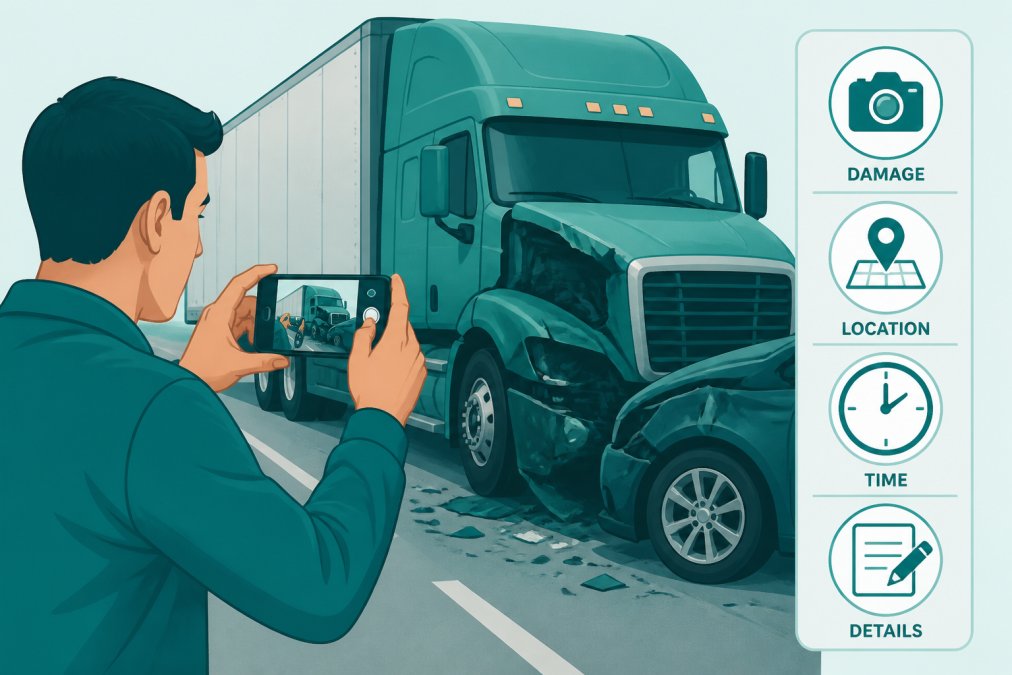
Before police clear the scene, document everything. Use your phone to take photos and video. This is your evidence; the insurance company won’t gather it for you.
Photograph:
- Overall scene from multiple angles (showing both vehicles, road conditions, lane markings, weather)
- Close-ups of all vehicle damage on both your vehicle and the commercial truck
- The tractor-trailer’s license plate and company name
- Road conditions (wet pavement, debris, potholes, poor lighting)
- Traffic signs and signals at the location
- Skid marks or other evidence of how the collision occurred
- Your injuries (visible bruises, cuts, swelling) if you have any
If there are witnesses at the scene, get their names, phone numbers, and email addresses. Ask them to briefly describe what they saw. Take photos of the commercial truck’s company information, including the truck number and any visible company logos or contact information.
Obtain a Police Report and Preserve Tractor Trailer Accident Evidence
Request the official collision report from the police department using the report number you got from the responding officer. Most police departments allow you to request reports online or by phone. The report typically becomes available within 5-10 business days.
The collision report includes the officer’s assessment of fault, statements from both drivers, witness information, weather and road conditions, and vehicle damage descriptions. This document is essential for your claim. Read it carefully. If there are factual errors, request a correction from the police department in writing.
Request the Collision Report
Contact the police agency that responded to your accident. Provide the report number and date of the accident. Some departments charge a small fee for copies. Request the report in writing and keep a copy for your records.
Preserve Electronic Logging Device and Black Box Data
Commercial trucks are required by the Federal Motor Carrier Safety Administration to have electronic logging devices (ELDs) that record driver hours, vehicle speed, braking patterns, and location data. Trucks also have event data recorders (black boxes) similar to those in aircraft. This data is crucial evidence that can prove driver fatigue, speeding, distracted driving, or mechanical failure.
Send a written preservation letter to the trucking company immediately. This letter demands that they preserve all electronic data, logbooks, maintenance records, and driver records related to the accident. Without this letter, trucking companies can legally delete ELD data after 30 days.
The preservation letter should include:
- Your name and contact information
- Date and location of the accident
- Vehicle identification numbers for all vehicles involved
- A specific demand to preserve ELD data, black box recordings, driver logbooks, maintenance records, GPS data, and any video footage from the truck’s cab or exterior cameras
- A statement that failure to preserve this evidence may result in sanctions and adverse inferences in litigation
Send this letter via certified mail with return receipt requested. Keep the receipt.
What Not to Do After a Truck Accident
The decisions you make in the hours after a collision can cost you tens of thousands in compensation.
Avoid Speaking with Insurance Adjusters Without Legal Counsel
Insurance adjusters will call you within 24-48 hours. They’ll sound friendly and say they want to “help resolve this quickly.” What they really want is a recorded statement that they can use to minimize your claim.
Do not give a recorded statement. Do not sign any documents. Do not accept an initial settlement offer. When the adjuster calls, say: “I appreciate you reaching out. I’m injured and working with an attorney. Please direct all future communication to my lawyer.” Then hang up.
Insurance companies know that injury victims are vulnerable immediately after accidents. They use recorded statements to lock you into a narrative that minimizes your injuries or assigns blame to you.
Do Not Post About the Accident on Social Media
Do not post about the accident, your injuries, your treatment, or your case on Facebook, Instagram, TikTok, or any other platform. Insurance adjusters and defense attorneys monitor social media. A photo of you smiling weeks after the accident can be used to argue your injuries aren’t as severe as you claim.
Set your social media accounts to private. Ask family and friends not to post about the accident. Wait until your case is resolved before resuming normal social media activity.
Understanding Commercial Truck Accident Claims and Liability
Truck accident claims are more complex than standard car accidents because multiple parties may be liable, and multiple insurance policies may apply.
Multiple Insurance Policies and FMCSA Regulations
A tractor-trailer accident typically involves the truck driver’s personal auto insurance, the trucking company’s commercial liability policy (the primary coverage), potentially the shipper’s or cargo owner’s insurance, and potentially the truck manufacturer’s product liability coverage if mechanical failure contributed.
Federal Motor Carrier Safety Administration regulations govern how trucking companies operate. Violations of these regulations, driver hours-of-service violations, inadequate vehicle maintenance, improper cargo loading, can establish negligence and strengthen your claim.
Common FMCSA violations that lead to accidents include driver fatigue, inadequate vehicle maintenance, speeding or reckless operation, improper cargo securing, and hiring drivers with safety violations or medical disqualifications. Your attorney will investigate whether the trucking company violated FMCSA regulations. If they did, that’s evidence of negligence.
Element | What It Means | Why It Matters |
|---|---|---|
Multiple policies | Truck, company, shipper, manufacturer all have insurance | More coverage available; more parties to pursue |
FMCSA violations | Federal safety regulation breaches | Establishes negligence; strengthens settlement use |
ELD data | Electronic logging device records | Proves driver fatigue, speeding, or mechanical issues |
Black box data | Event data recorder from truck | Captures speed, braking, acceleration at moment of impact |
Preservation letter | Written demand to keep evidence | Prevents destruction of critical data |
When to Contact a Truck Accident Lawyer
Contact a truck accident attorney within 48 hours of the collision. The first 48 hours are critical for evidence preservation and preventing you from making statements that hurt your claim.
A truck accident lawyer will send preservation letters to the trucking company, truck manufacturer, and other parties; obtain and analyze the police report, ELD data, and black box recordings; investigate the trucking company’s safety record and maintenance history; identify all liable parties and their insurance coverage; handle all communication with insurance adjusters; build your medical documentation and injury narrative; and negotiate with insurance companies or prepare for trial.
At Merritt & Merritt Law Firm, we handle truck accident cases with the urgency they demand. We investigate immediately. We preserve evidence before it’s destroyed. We hold trucking companies and their insurers accountable for the injuries they cause. With over 45 years of trial experience, we know how insurance companies think and how to counter their tactics.
We offer 24-hour availability and can meet you in your home, office, or hospital. We work on contingency, which means you pay nothing unless we recover compensation for you. Your focus right now is healing. Our focus is your case.
A tractor-trailer accident is a medical and legal emergency. The injuries are often severe, the evidence is time-sensitive, and the insurance companies are already investigating. Your actions in the first 48 hours determine whether you recover full compensation or get pressured into a lowball settlement. Contact Merritt & Merritt Law Firm for a free case evaluation and let us handle the fight while you focus on recovery. Federal Motor Carrier Safety Administration regulations establish the safety standards trucking companies must follow, and violations of those standards are evidence we use to prove negligence. We’ve helped accident victims in Georgia, Florida, Texas, and across the nation recover millions in compensation. Schedule your consultation today.
Frequently Asked Questions
What is the first thing to do immediately after a tractor trailer accident?
Your first priority after a tractor trailer accident is to ensure safety. Move yourself and passengers to a secure location away from traffic if possible, activate hazard lights, and call 911 to report the accident and request emergency services. Once emergency responders arrive, provide basic information about injuries and request an ambulance if anyone needs medical attention. Only after safety is secured should you begin gathering evidence at the accident scene.
What tractor trailer accident evidence should I preserve at the scene?
Critical evidence includes photographs of vehicle damage, the accident scene, road conditions, and traffic signals. Collect witness names and contact information. Request the police report number. For commercial vehicles, preserve information about driver logbooks and electronic logging devices (black box/EDR data), as these record speed, braking, and hours of service—crucial for proving negligence. Document the trucking company name and insurance details. Preserve all medical records and incident documentation related to your injuries.
Should I talk to the insurance adjuster or trucking company representative after a truck accident?
You should avoid detailed conversations with insurance adjusters or trucking company representatives without legal counsel present. Anything you say can be used against your claim. You can provide basic identifying information, but do not admit fault, speculate about the accident, or discuss your injuries in detail. Contact a truck accident lawyer before signing any documents or giving recorded statements. An attorney can handle communications with the insurance company to protect your rights and ensure fair compensation.
When should I hire a truck accident lawyer after a tractor trailer accident?
You should contact a truck accident lawyer as soon as possible after a tractor trailer accident, ideally before speaking with insurance adjusters. Early legal representation helps preserve evidence, protect your rights, and prevent statements that could harm your claim. Commercial truck accident claims often involve complex federal regulations, multiple insurance policies, and significant liability issues that require expert legal guidance. Many firms offer free consultations and work on contingency, meaning you pay only if you win your case.
Our Locations

Atlanta/Decatur
1 West Court Square
Suite 750
Decatur, GA 30030

Savannah
100 Bull Street
Suite 200
Savannah, GA 31401

Statesboro
15 West Main Street
Statesboro, GA 30458

Houston
1415 Louisiana Street,
Suite 1800,
Houston, TX 77002

Jacksonville
841 Prudential Drive
12th Floor
Jacksonville, FL 32207

Contact Us
© Copyright 2026 Merritt & Merritt Law Firm. All rights reserved.