
call us 24/7 1-800-738-WE-WIN
call us 24/7 1-800-738-WE-WIN
Serving All of Georgia, Florida, & Texas
Document Car Accident Injuries: 7 Essential Steps

Table of Contents
- Why Documenting Car Accident Injuries Matters for Your Claim
- Step 1: Seek Immediate Medical Attention and Create Official Records
- Step 2: Collect and Preserve Digital Evidence at the Accident Scene
- Step 3: Document the Accident Scene and Gather Witness Statements
- Step 4: Exchange Driver and Insurance Information Properly
- Step 5: Maintain a Detailed Injury Documentation Log
- Step 6: Avoid the ‘Gap in Treatment’ Trap and Document Psychological Injuries
- Step 7: Obtain Police Reports and Work With Your Insurance Adjuster
Last Updated: July 19, 2026
When you’re injured in a car accident, documenting your injuries thoroughly is one of the most critical actions you can take, it directly impacts your ability to recover compensation. Insurance companies and courts rely heavily on medical evidence, not just your word, to determine claim value. At Merritt & Merritt Law Firm, we’ve spent over 45 years helping accident victims build ironclad injury documentation that secures fair settlements. Below, we’ll walk you through exactly how to create a documentation trail that protects your rights and maximizes your recovery.
Call the Merritt & Merritt Law Firm today at 404-975-1775.
Why Documenting Car Accident Injuries Matters for Your Claim
Your injury documentation becomes the foundation of your entire personal injury claim. Insurance adjusters won’t accept your word that you’re in pain, they need medical records, diagnostic imaging, treatment plans, and witness statements to justify a settlement. Without proper documentation, even severe injuries can be undervalued or denied entirely.
Many accident victims make critical mistakes early on that undermine their cases months later. Some delay seeking medical attention, creating a “gap in treatment” that insurers use to argue injuries weren’t serious. Others fail to photograph the accident scene or collect witness contact information. Still others document their pain inconsistently, making it easy for adjusters to claim exaggeration.
A comprehensive injury documentation log, combined with medical records, photos, and witness statements, can mean the difference between a lowball settlement and one that covers your medical bills, lost wages, and pain and suffering.
Step 1: Seek Immediate Medical Attention and Create Official Records
Get evaluated by a medical professional within 24-48 hours of the accident. This ensures you receive necessary treatment and creates an official medical record with a timestamp proving your injuries are connected to the accident.
Call 911 or go to an emergency room if you have loss of consciousness, severe pain, difficulty breathing, visible deformities, or any head or spine injury. Emergency responders will document your condition, and the hospital will create imaging and medical records that carry significant weight in your claim.
Even if you feel “okay” at the scene, visit urgent care or your primary care physician within a day. Many serious injuries, whiplash, internal injuries, traumatic brain injury, don’t show symptoms immediately. Getting evaluated early protects you medically and legally.
At your medical appointment, be specific about your symptoms. Don’t say “my back hurts.” Say “I have sharp pain in my lower back that radiates down my right leg, worse when I bend forward or sit for more than 20 minutes.” Doctors document what you tell them, and those precise descriptions become evidence in your claim.
:::pro-tip Tell your doctor about ALL symptoms, even ones that seem minor. Headaches, dizziness, sleep disruption, and anxiety all matter. Many accident victims downplay symptoms at their first visit and regret it later. :::
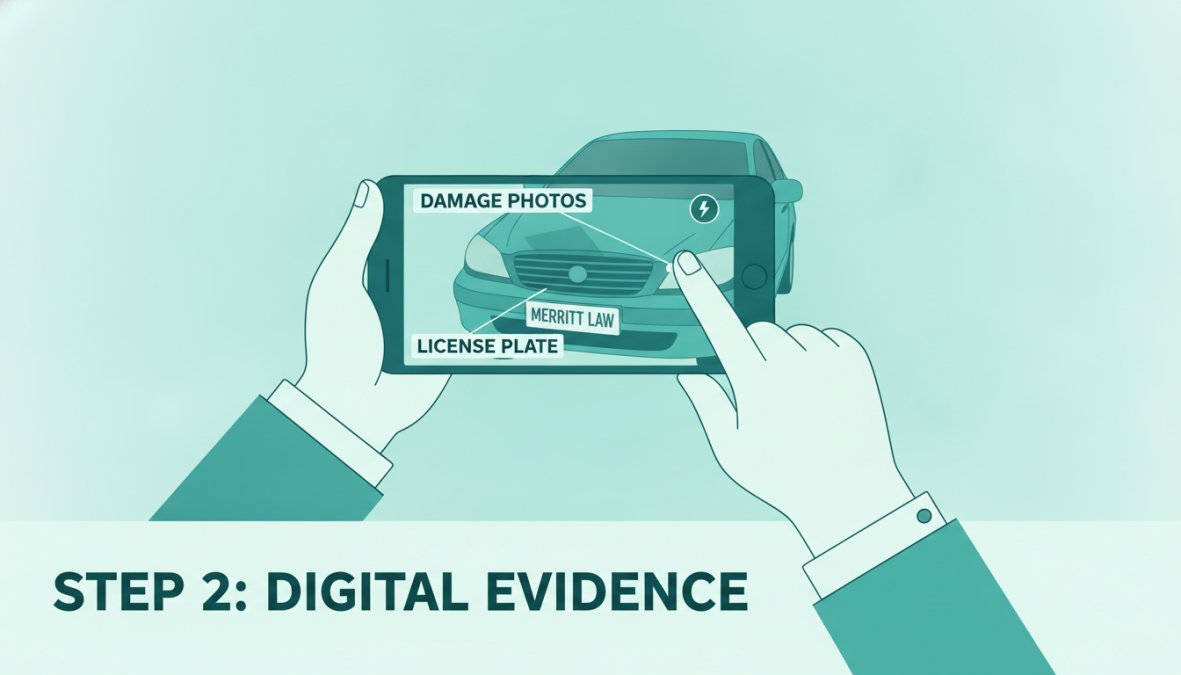
Step 2: Collect and Preserve Digital Evidence at the Accident Scene
Digital evidence, photos, videos, and metadata, creates a visual record of liability and damages that no written description can match. Photograph everything at the accident scene thoroughly.
Start with wide shots showing the overall scene: the road, traffic signals, weather conditions, and vehicle positions. Then photograph vehicle damage in detail, close-ups of dents, broken glass, bent metal, and damage to the other driver’s vehicle. Photograph your injuries if they’re visible: bruises, cuts, swelling, or scarring. Take these photos within hours of the accident while injuries are most apparent, and continue over the following days as they change.
Video is even more powerful than still photos. Record a 30-60 second video walking around the accident scene, narrating what you see: “This is the intersection of Main and Fifth. The traffic light is red in my direction. The other vehicle ran the red light and struck my car on the driver’s side.”
Upload your photos and videos to cloud storage immediately, Google Drive, iCloud, OneDrive, or Dropbox. This creates a backup and a timestamped record that’s harder to dispute. Create a dedicated folder labeled with the accident date and organize your digital evidence clearly.
Step 3: Document the Accident Scene and Gather Witness Statements
Witness statements are often the most powerful evidence in determining liability. A neutral third party’s account carries more weight than either driver’s story.
If anyone witnessed the accident, get their name, phone number, email address, and home address before they leave the scene. Ask them to write a brief statement describing what they saw. Don’t rely on police to collect witness information, police reports often have incomplete details. Get the information yourself while witnesses are still present and their memories are fresh.
Write down everything about the accident scene relevant to how it happened: weather (rain, snow, fog), road conditions (wet, icy, potholed), visibility, and traffic signals. If the accident occurred at an intersection, note whether traffic signals were working and what color the light was in your direction. These scene details establish the context of liability.
Step 4: Exchange Driver and Insurance Information Properly
At the accident scene, exchange driver and insurance information with the other driver(s) involved. Get their full name, phone number, address, driver’s license number, license plate number, vehicle make and model, and insurance policy information.
Take a photo of their driver’s license and insurance card with your phone. Do NOT sign anything at the scene except police reports if requested. Do NOT make statements admitting fault or apologizing for the accident. Stick to the facts: “I was traveling north on Main Street when the other vehicle struck my car.”
Step 5: Maintain a Detailed Injury Documentation Log
A daily injury documentation log is a simple but powerful record of how your injuries affect you day-to-day. Starting the day of the accident and continuing for weeks or months, keep a log documenting your pain levels, symptoms, and limitations.
Use a simple format: date, time, pain level (1-10 scale), specific symptoms, and how symptoms affected your activities. Example entry: “July 15, 2026, 9:00 AM. Pain level 8/10. Sharp pain in lower back radiating to right hip. Unable to sit for more than 10 minutes. Took ibuprofen and applied ice. Skipped my morning run.”
Be specific about how your injuries limit your daily life. Did you miss work? Skip exercise? Have trouble sleeping? Need help with household tasks? Update your log consistently, ideally at the same time each day. Consistency matters because insurance adjusters scrutinize logs for gaps or inconsistencies.
Document any work you miss due to your injuries. Note the date, hours missed, and reason. Keep pay stubs or ask your employer for a letter confirming missed dates and hours. Beyond lost wages, document how your injuries affect your lifestyle, if you can’t exercise, participate in hobbies, or help with childcare.
Step 6: Avoid the ‘Gap in Treatment’ Trap and Document Psychological Injuries
One of the most damaging mistakes accident victims make is stopping treatment too soon or taking long breaks between appointments. Insurance companies call these “gaps in treatment” and use them to argue injuries weren’t serious.
If you see a doctor immediately after the accident, then don’t return for three months, an insurance adjuster will argue: “If the injuries were serious, why did they wait three months for follow-up care?” Consistency in treatment is critical. Follow your doctor’s treatment plan, attend appointments as recommended, and take prescribed medication as directed.
Car accidents often cause psychological injuries alongside physical ones: anxiety, depression, post-traumatic stress, sleep disruption, and fear of driving. If you experience these symptoms, see a mental health professional. Document your symptoms and how they affect your daily life. Note if anxiety prevents you from driving, if depression affects your work performance, or if sleep disruption leaves you exhausted.
Step 7: Obtain Police Reports and Work With Your Insurance Adjuster
The police report is an official document that establishes what happened and who was at fault. Request a copy from the police department that responded to the accident. Review it carefully once you receive it and check that your information is accurate.
Once you have your medical records, photos, witness statements, police report, and injury documentation log, you’re ready to communicate with your insurance adjuster. Don’t volunteer information, answer questions directly but briefly. Provide your medical records and injury log rather than discussing details verbally.
Never accept the first settlement offer without reviewing it carefully. Calculate your actual damages: medical bills, lost wages, property damage, and a reasonable estimate of pain and suffering. If the adjuster’s offer is significantly lower than your damages, push back with your documentation. Point to specific medical records, diagnostic imaging, treatment plans, and your injury log.
Documentation Element | Timeline | Purpose | Evidence Weight |
|---|---|---|---|
Medical evaluation | Within 24-48 hours | Create official medical record | High |
Accident scene photos | Immediately | Establish liability and damages | High |
Witness statements | Within hours of accident | Corroborate your account | High |
Police report | 5-10 business days | Official third-party account | High |
Injury documentation log | Daily for weeks/months | Demonstrate ongoing impact | Medium-High |
Medical records and imaging | Throughout treatment | Prove injury severity | High |
Psychological evaluation | As soon as symptoms appear | Document mental health damages | Medium-High |
Lost wage documentation | Throughout recovery | Quantify economic damages | High |
Documenting car accident injuries thoroughly takes time and discipline, but it’s the most important investment you can make in your recovery. Insurance companies have teams of adjusters trained to minimize payouts. Your detailed documentation levels the playing field.
If you’re injured in a car accident and facing pushback from an insurance adjuster, Merritt & Merritt Law Firm can help. With over 45 years of trial experience, our team investigates claims thoroughly, holds liable parties accountable, and secures settlements that reflect the true value of your injuries. We offer 24-hour service and can meet you in your home, office, or hospital. You pay only if we win. Schedule a free consultation today and let our team fight for the compensation you deserve.
Frequently Asked Questions
What are the most important steps to document car accident injuries?
The critical steps are: (1) seek immediate medical attention and create official medical records, (2) photograph the accident scene and preserve digital evidence, (3) collect witness contact information and statements, (4) exchange driver and insurance information, (5) maintain a detailed daily injury log, (6) ensure continuous follow-up care to avoid treatment gaps, and (7) obtain the police report. Each step builds evidence for your personal injury claim and protects your legal rights.
How do I preserve digital evidence and avoid losing accident documentation?
Take photos and videos immediately at the scene using your smartphone, capturing vehicle damage, accident scene conditions, and your visible injuries. Upload files to cloud storage (Google Drive, iCloud, OneDrive) within 24 hours to preserve metadata and protect against device loss. Create a separate folder for each category: vehicle damage, scene conditions, medical records, and witness statements. Keep originals with timestamps intact—never edit or crop evidence photos, as insurance adjusters and legal teams verify authenticity.
What is the 'gap in treatment' trap and why does it hurt my personal injury claim?
A treatment gap occurs when you stop receiving medical care and then resume it weeks or months later. Insurance adjusters and opposing counsel interpret gaps as proof your injuries weren't serious—even if financial hardship or scheduling caused the break. To protect your claim, schedule follow-up appointments immediately, maintain consistent medical documentation, and communicate with your healthcare provider about any delays. If gaps are unavoidable, document the reason in writing to your medical team.
Should I talk to insurance adjusters before documenting my injuries, and what should I avoid?
Do not give recorded statements or sign documents before consulting an attorney. Insurance adjusters are trained to minimize payouts. Instead, gather complete medical records, police reports, and photographic evidence first. Provide only essential information: names, policy numbers, and basic facts. Avoid admitting fault, speculating about injuries, or accepting quick settlement offers. An attorney can review all documentation and communications to ensure your rights are protected and you receive fair compensation for damages and pain and suffering.
Our Locations

Atlanta/Decatur
1 West Court Square
Suite 750
Decatur, GA 30030

Savannah
100 Bull Street
Suite 200
Savannah, GA 31401

Statesboro
15 West Main Street
Statesboro, GA 30458

Houston
1415 Louisiana Street,
Suite 1800,
Houston, TX 77002

Jacksonville
841 Prudential Drive
12th Floor
Jacksonville, FL 32207

Contact Us
© Copyright 2026 Merritt & Merritt Law Firm. All rights reserved.