
call us 24/7 1-800-738-WE-WIN
call us 24/7 1-800-738-WE-WIN
Serving All of Georgia, Florida, & Texas
What to Do After a Tractor Trailer Accident: 7 Critical Steps

Table of Contents
- What to Do Immediately After a Tractor Trailer Accident
- Call 911 and Report the Accident
- Document the Accident Scene and Preserve Evidence
- Gather Witness Information and Evidence After Truck Accident
- Exchange Information and Navigate Commercial Truck Accident Claims
- When to Contact a Truck Accident Lawyer and Pursue Personal Injury After Truck Accident
- Common Mistakes to Avoid After a Tractor Trailer Accident
- Your Next Steps: Getting Support and Compensation
Last Updated: July 18, 2026
If you’ve been involved in a tractor trailer accident, the immediate aftermath is overwhelming. Understanding what to do can mean the difference between protecting your health, preserving critical evidence, and securing fair compensation. This guide walks you through exactly what to do, from the first moments at the scene through working with legal counsel.
Call the Merritt & Merritt Law Firm today at 404-975-1775.
What to Do Immediately After a Tractor Trailer Accident
The first moments after impact determine your safety and the strength of your case later. Your priority is getting yourself and others out of immediate danger, then documenting what happened before memories fade and evidence disappears.
Move to a Safe Location and Turn On Hazard Lights
If your vehicle is operable and you’re not severely injured, move it away from traffic and turn on your hazard lights immediately. If your vehicle won’t move or you’re badly hurt, stay inside with doors locked and wait for emergency responders. Tractor trailers create massive blind spots; a second collision is a real risk. Once at a safe distance, assess your injuries. Adrenaline masks pain, and many accident victims don’t realize they’re injured until hours later.
Seek Medical Attention Immediately
Call 911 even if you think your injuries are minor. Tractor trailer accidents involve massive force; injuries that seem insignificant at the scene often develop into serious problems. Internal bleeding, spinal injuries, and traumatic brain injuries don’t always show symptoms immediately. A medical evaluation creates an official record linking your injuries to the accident, which is critical for your claim.
Tell the paramedics exactly what happened and where you feel pain. Be specific about any loss of consciousness, vision changes, dizziness, or difficulty concentrating. If you’re not transported to a hospital, seek medical attention within 24 hours. Waiting days to see a doctor weakens your injury claim.
Call 911 and Report the Accident
Calling 911 gets emergency responders to the scene and creates an official police report. The police report is one of your most valuable pieces of evidence, documenting the accident scene, vehicle damage, road conditions, and the truck driver’s statements while details are fresh.
When you call, provide the dispatcher with your location, the number of vehicles involved, and whether anyone is injured. Tell them a commercial truck is involved. Once emergency responders arrive, cooperate fully with police but keep your answers factual and brief. Don’t speculate about negligence. Stick to what you observed: “I was stopped at a red light when the truck hit me from behind.”
Request the police report number before leaving the scene and ask the officer for their contact information.
Document the Accident Scene and Preserve Evidence
The accident scene tells the story of what happened. Photographs, video, and physical evidence preserve that story before the scene is cleaned up. This documentation is especially important in tractor trailer accidents because commercial vehicles are subject to federal regulations, and evidence of violations can dramatically increase your settlement value.
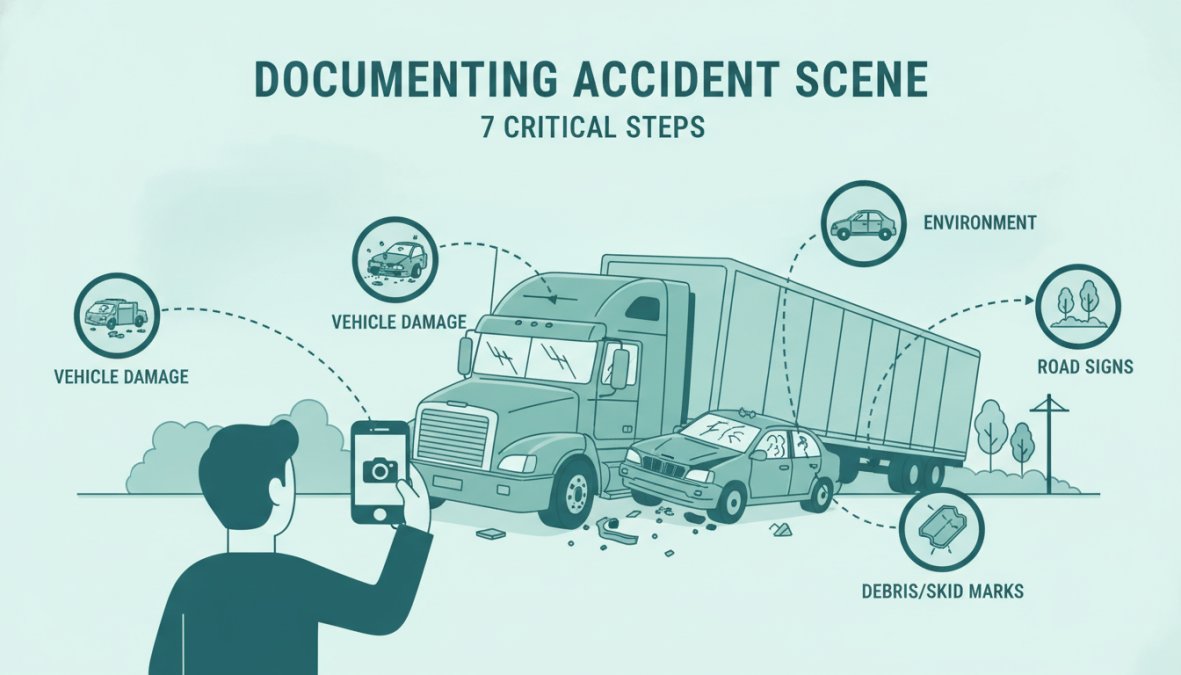
Photograph and Video Documentation
Take photos and video of everything while you’re at the scene. Photograph the entire accident scene from multiple angles: wide shots showing the overall scene, medium shots of vehicle damage, and close-ups of specific damage areas. Document the truck’s position relative to your vehicle and the roadway. Photograph skid marks, debris, road conditions, weather, lighting, and visibility. Document the truck’s cargo area, license plate, and company markings. Record a walking video of the entire accident scene, narrating what you see.
Preserve Black Box (EDR) Data and Trucking Records
Tractor trailers are equipped with electronic data recorders (EDRs), also called “black boxes.” These devices record the truck’s speed, braking, engine performance, and lane position in the seconds before and after a crash. This data is invaluable because it often proves the truck driver was speeding, failed to brake, or was driving erratically. However, this data can be overwritten or deleted if you don’t act quickly.
Send a spoliation letter to the trucking company immediately, within days of the accident. A spoliation letter is a formal demand that the company preserve all evidence related to the accident, including black box data, maintenance records, driver logbooks, and GPS records. Without this letter, trucking companies can legally delete black box data after 30 days.
The truck driver’s logbook is another critical record. Federal Motor Carrier Safety Administration (FMCSA) regulations require drivers to maintain accurate records of hours worked and rest periods. If the driver was fatigued or exceeding legal driving hours, that’s evidence of negligence. Request the driver’s personnel file, including training records, accident history, and disciplinary actions.
Gather Witness Information and Evidence After Truck Accident
Witness statements are powerful evidence because they come from neutral parties with no financial stake in the outcome. A witness who saw the truck run a red light or saw the driver texting is far more credible than your own account.
If there are other vehicles at the scene, get the driver’s name, phone number, address, vehicle description, and insurance information. Ask them what they saw and write down their statement. Get names and contact information of any passengers and pedestrians who witnessed the accident.
For commercial truck accidents, nearby business owners may have security camera footage. If the accident occurred near a gas station, restaurant, or store, ask the manager whether their cameras captured the accident and request that they preserve the footage. Many businesses record over footage after 30 days, so this is time-sensitive.
Exchange Information and Navigate Commercial Truck Accident Claims
What to Exchange at the Scene
Get the truck driver’s name, phone number, and address. Get the trucking company name and address. Ask for the driver’s commercial driver’s license (CDL) number and the truck’s Vehicle Identification Number (VIN). Get the insurance company name and policy number from the truck’s insurance card. Take a photo of the insurance card.
Do not sign any documents at the scene except the police report. Do not accept cash as settlement. Do not agree to any statement about fault or injuries. Get the names and badge numbers of police officers at the scene.
Avoid Speaking with Trucking Company Representatives
After the police leave, a representative from the trucking company or its insurance carrier will contact you. They’ll sound friendly and helpful, but they want to get you to make statements that limit your claim. Insurance adjusters are trained to ask leading questions designed to get you to admit fault or minimize your injuries.
Do not give a recorded statement to the trucking company’s insurance carrier. You have no legal obligation to do so. If they pressure you, say: “I’m not providing a statement without my attorney present.”
When to Contact a Truck Accident Lawyer and Pursue Personal Injury After Truck Accident
The moment you realize you’ve been in a tractor trailer accident, contact a personal injury attorney. This protects your rights from day one, starting with preserving evidence and preventing the insurance company from taking advantage of you.
Why Legal Representation Matters for Commercial Vehicle Claims
Tractor trailer accident claims are fundamentally different from standard car accident claims. The truck is owned by a commercial company, not an individual. The insurance policy is a commercial policy with different coverage limits. Federal regulations govern how the truck is maintained, how long the driver can work, and how accidents must be reported. These complexities make commercial vehicle claims far more valuable than typical car accidents, but only if you know how to navigate them.
An experienced truck accident lawyer identifies all liable parties: the truck driver, the trucking company (for inadequate training or maintenance), the truck manufacturer (for defective brakes), the cargo loader (for improper weight distribution), or the shipper (for hazardous materials). Each liable party represents additional insurance coverage and potential damages.
Your attorney will immediately send a preservation letter to the trucking company, preventing destruction of black box data and other evidence. They’ll request driver logbooks, maintenance records, and safety history. By the time the insurance company makes an offer, your attorney has already built a strong case.
Understanding Statute of Limitations and Negligence Claims
The statute of limitations is the deadline for filing a lawsuit. In most states, you have two to three years from the date of the accident to sue. Don’t wait until the deadline approaches to contact an attorney. Evidence degrades over time, witnesses move or forget details, and the longer you wait, the weaker your case becomes.
To win a personal injury claim, you must prove negligence: duty, breach, causation, and damages. The truck driver had a duty to operate the truck safely and follow traffic laws. If they breached that duty by speeding, running a red light, or failing to brake, that’s negligence. You must prove the breach caused your injuries and that you have actual damages (medical bills, lost wages, pain and suffering).
Damages include economic damages (medical bills, lost wages, vehicle repair) and non-economic damages (pain and suffering, emotional distress, loss of enjoyment of life). If you suffered a serious injury, your non-economic damages can be substantial.
Common Mistakes to Avoid After a Tractor Trailer Accident
Don’t post about the accident on social media. Insurance adjusters monitor social media constantly. If you post that you’re “fine” or “lucky,” they’ll argue your injuries aren’t serious. Keep your accident and recovery completely off social media until your case is resolved.
Don’t accept the first settlement offer. Insurance companies make lowball offers hoping you’ll accept quickly. Your attorney will negotiate aggressively to get you fair compensation.
Don’t miss medical appointments or stop treatment early. Insurance companies use gaps in medical care to argue your injuries weren’t serious. Continue treatment as long as your doctor recommends it.
Don’t give recorded statements to the trucking company’s insurance carrier. Let your attorney handle all communication with insurance companies.
Don’t sign any documents without your attorney reviewing them. Signing a release without understanding what you’re giving up can permanently bar you from recovering additional damages if your condition worsens.
Your Next Steps: Getting Support and Compensation
The steps you take in the first hours and days after a tractor trailer accident determine the trajectory of your case. Prioritizing safety, documenting the scene, and seeking immediate legal representation create a foundation for fair compensation.
Contact Merritt & Merritt Law Firm for a free consultation. Our team has over 45 years of trial experience handling personal injury and commercial vehicle accident claims. We understand the unique complexities of tractor trailer accidents, from black box data to FMCSA regulations. We offer 24-hour availability and work on contingency, meaning you pay nothing unless we win your case.
During your free consultation, we’ll review what happened, explain your legal options, and answer your questions. We’ll tell you honestly whether we believe you have a strong case and what compensation you might expect. We’ll immediately begin preserving evidence and building your claim.
If you’ve been injured in a tractor trailer accident, don’t navigate the insurance company alone. Contact Merritt & Merritt Law Firm today for a free case evaluation. With over 45 years of trial experience, immediate case investigation, and 24-hour availability, we’re committed to holding liable parties accountable and securing the compensation you deserve. You pay nothing unless we win your case.
Step | Timing | Key Action |
|---|---|---|
Move to safety and seek medical attention | Immediately | Call 911, move away from traffic, get evaluated |
Document the scene | At the scene | Photograph damage, road conditions, truck details |
Gather witness information | At the scene | Collect names, phone numbers, statements |
Call your attorney | Within 24 hours | Request preservation of evidence and black box data |
Avoid insurance company statements | Ongoing | Refuse recorded statements, direct all communication to your attorney |
Obtain medical records and police report | Within one week | Gather all documentation for your claim |
Negotiate settlement or prepare for litigation | As directed by attorney | Let your attorney handle all negotiations |
Frequently Asked Questions
What is the first thing to do after a tractor trailer accident?
First, ensure your safety by moving to a safe location away from traffic if possible, and turn on your hazard lights. Check yourself and any passengers for injuries. Call 911 immediately to report the accident and request emergency responders. Do not leave the scene. Once emergency responders arrive, cooperate with them and provide basic information about the collision. Avoid discussing fault or accepting blame at this stage—focus on safety and getting medical evaluation.
Should I talk to the trucking company's insurance adjuster before contacting a truck accident lawyer?
It's generally advisable to avoid detailed conversations with the trucking company's insurance adjuster without legal counsel present. Insurance adjusters may ask leading questions or request recorded statements that could be used against you later. While you should exchange basic contact and insurance information at the scene, any detailed claims discussion should wait until you've consulted with a personal injury attorney who understands commercial vehicle liability and trucking-specific insurance complexities. An attorney can ensure your rights are protected.
What evidence after truck accident is most important to preserve?
Critical evidence includes photographs of the accident scene, vehicle damage, road conditions, and traffic signs. Collect witness statements and contact information. Request the police report and crash documentation. Preserve the truck driver's logbook and hours-of-service records, which are required by FMCSA regulations. Most importantly, send a spoliation letter immediately to preserve the semi-truck's black box (EDR) data—this electronic data contains crucial information about speed, braking, and driver actions before impact. This evidence is often lost or destroyed if not formally preserved.
How long do I have to file a lawsuit after a tractor trailer accident?
The statute of limitations varies by state but typically ranges from two to four years for personal injury claims. However, time is critical for evidence preservation—witness memories fade, and commercial vehicle records may be destroyed. Contact a truck accident lawyer promptly to understand your state's specific deadline and to ensure evidence preservation begins immediately. Waiting too long can compromise your ability to gather critical evidence like black box data, which has a limited retention period on many commercial vehicles.
Our Locations

Atlanta/Decatur
1 West Court Square
Suite 750
Decatur, GA 30030

Savannah
100 Bull Street
Suite 200
Savannah, GA 31401

Statesboro
15 West Main Street
Statesboro, GA 30458

Houston
1415 Louisiana Street,
Suite 1800,
Houston, TX 77002

Jacksonville
841 Prudential Drive
12th Floor
Jacksonville, FL 32207

Contact Us
© Copyright 2026 Merritt & Merritt Law Firm. All rights reserved.