
call us 24/7 1-800-738-WE-WIN
call us 24/7 1-800-738-WE-WIN
Serving All of Georgia, Florida, & Texas
Steps to Take After a Car Accident: Complete Guide
Table of Contents
- Immediate Steps to Take After a Car Accident
- Car Accident Checklist: What to Document at the Scene
- Filing a Police Report After a Car Accident
- Insurance Claim After a Car Accident: Next Steps
- Personal Injury Claim After a Car Accident: Protecting Your Rights
- Digital Evidence Preservation and Communication After Steps to Take After a Car Accident
- When to Seek Legal Counsel for Your Accident Claim
- Conclusion
Steps to Take After a Car Accident: Complete Guide
Last Updated: July 17, 2026
When you’re involved in a car accident, the immediate aftermath is overwhelming. Understanding the steps to take can mean the difference between a smooth insurance claim and months of complications. This guide walks you through every critical action from the first moments after impact through settlement.
Call the Merritt & Merritt Law Firm today at 404-975-1775.
Immediate Steps to Take After a Car Accident
The first minutes after a collision determine everything that follows. Your priority is safety, then documentation, then communication.
Check for Injuries and Move to Safety
Check yourself and your passengers for injuries immediately. Even if you feel fine, adrenaline masks pain. Look for obvious signs: bleeding, difficulty moving, chest pain, or neck stiffness.
If anyone is injured, do not move them unless there’s immediate danger. Call 911 immediately and let emergency responders handle patient movement. If the accident is minor and everyone is uninjured, move vehicles out of traffic if safe. Turn on hazard lights. If you can’t move the vehicle safely, stay inside with your seatbelt on.
Call 911 and Report to Police
Call 911 immediately if anyone is injured or if there’s significant property damage. Most insurance claims require a police report, and some states legally require reporting accidents above a certain damage threshold.
When police arrive, give factual information: location, time, vehicle descriptions, and what you observed. Do not speculate about how the accident happened or who was at fault. Request the police report number before the officer leaves, you’ll need this for your insurance claim.
Car Accident Checklist: What to Document at the Scene
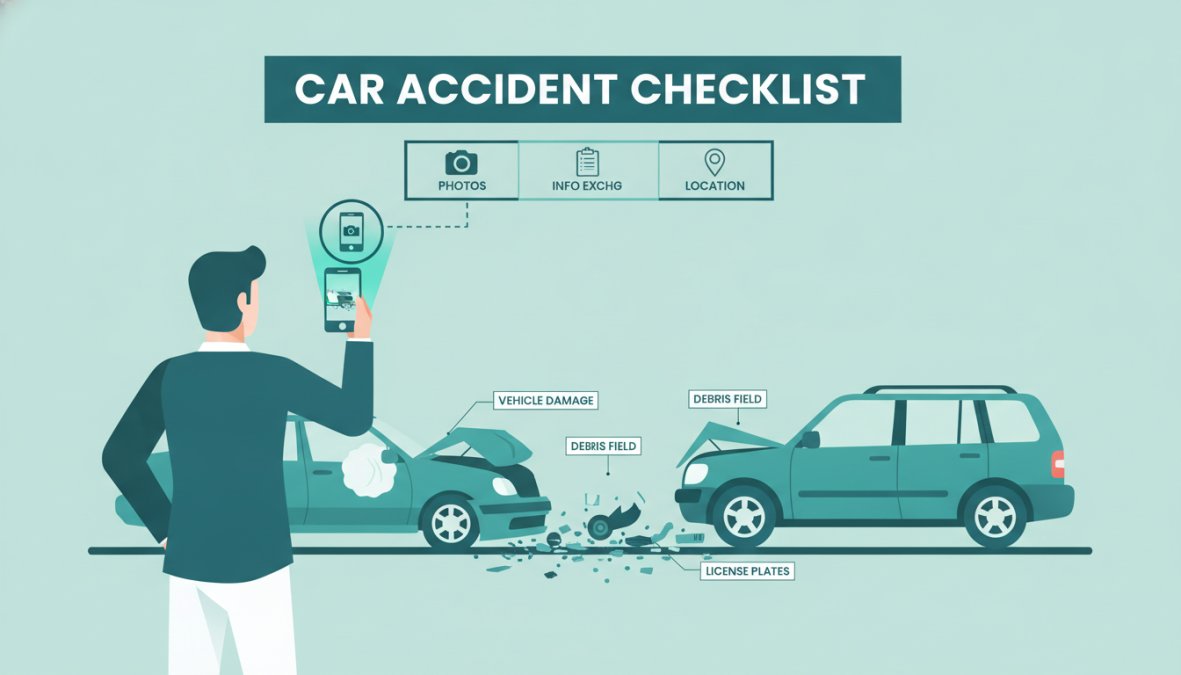
Documentation is your insurance policy against disputes later. The more information you gather at the scene, the stronger your claim becomes.
Gather Driver Information and Exchange Details
Get the other driver’s full name, phone number, email address, and home address. Photograph their driver’s license. Request their vehicle information: make, model, year, color, and license plate number. Get their insurance company name, policy number, and agent contact information.
If there are multiple vehicles involved, repeat this process for each driver. If the other driver refuses to provide information, note that they refused, get their license plate number, and let police handle it.
Collect Witness Contact Information
Witnesses are invaluable, they have no stake in the outcome. Get the name, phone number, and email address of everyone who saw the accident. Ask each witness to briefly describe what they saw using open-ended questions. Write down their exact words when possible.
Take Photos and Video Evidence
Photograph everything: wide shots showing vehicle positions and road conditions, close-ups of all vehicle damage, the accident location from multiple angles, weather conditions, and time of day. Photograph street signs showing location and any visible traffic cameras.
Record a brief video walking around the scene, narrating what you see. Do not delete any photos or videos. Store them in cloud storage immediately and do not edit or alter images in any way.
Filing a Police Report After a Car Accident
The police report becomes the official record of the accident. Insurance companies use it as a reference point, and it’s admissible in court.
Understanding Police Reports and SR-1 Forms
The police report documents the officer’s observations: accident location, time, weather, vehicle positions, and statements from drivers and witnesses. Some states use a specific form called an SR-1 for accident reporting, a standardized document capturing essential information.
Request a copy of the police report immediately. Review it carefully for accuracy. If there are errors, wrong vehicle descriptions, incorrect statements, or factual mistakes, contact the police department and request a correction or addendum.
What Not to Say to Police or Other Drivers
Never admit fault or speculate about how the accident happened. Stick to observable facts: “The traffic light was green” or “I was traveling at the posted speed limit.”
Do not speculate about injuries or discuss insurance with other drivers. Do not post about the accident on social media, anything you post can be screenshotted and used against you.
Insurance Claim After a Car Accident: Next Steps
Your insurance claim is a formal process with specific timelines and requirements. Missing deadlines or providing incomplete information can result in claim denial.
Notify Your Insurance Agent Promptly
Contact your insurance company within 24 hours of the accident. Have your policy number ready and provide the police report number, the other driver’s information, and a brief description of what happened.
Your agent will assign an adjuster to investigate the accident, review documentation, and determine liability and damages. Be cooperative with the adjuster, but remember they work for the insurance company, not for you. Provide all documentation you’ve gathered: photos, video, witness statements, and medical records.
Do not accept the first settlement offer if you believe it’s inadequate. You have the right to negotiate.
Organize Documentation for Your Adjuster
Create a file containing every document related to your accident: police report, photos and video, witness statements, the other driver’s information, medical records, repair estimates, and correspondence with the insurance company.
Write a timeline of events with dates and times. Keep a log of all expenses: medical bills, repair costs, rental car fees, and lost wages. Submit documentation in writing (email with read receipts or certified mail) rather than over the phone to create a record.
Personal Injury Claim After a Car Accident: Protecting Your Rights
Not all accident injuries are immediately obvious. Some develop over days or weeks.
Seek Medical Attention and Keep Records
See a doctor within 24-48 hours of the accident, even if you feel fine. Many injuries like whiplash, internal injuries, and concussions don’t show symptoms immediately.
Describe all symptoms to your doctor, no matter how minor. Keep every medical record, test result, prescription, and receipt. Follow your doctor’s treatment recommendations, gaps in treatment will be used against you in your claim.
Managing Psychological Impact and Trauma
Car accidents create psychological trauma that’s often overlooked. Anxiety, depression, PTSD, and sleep disturbances are common and deserve treatment and compensation.
If you’re experiencing anxiety or trauma symptoms, see a mental health professional. Document these visits the same way you document physical medical care. Keep a journal of how the accident affects your daily life, difficulty sleeping, anxiety while driving, or avoidance of certain roads.
Digital Evidence Preservation and Communication After Steps to Take After a Car Accident
In 2026, digital evidence is often more valuable than physical evidence. Your phone, email, and online communications create a detailed record of the accident and its aftermath.
Dashcam and Mobile Phone Evidence
Dashcam footage is highly valued by insurance companies. If you have it, preserve it immediately and upload to cloud storage. Your phone’s location history can establish your route and position at the time of the accident.
Text messages, emails, and voicemails related to the accident are evidence. Don’t delete conversations with the other driver, witnesses, or the insurance company. Screenshots of text message threads with dates and times are admissible as evidence.
Avoiding Common Mistakes in Post-Accident Communication
Don’t discuss the accident with the other driver after the scene. If they contact you, respond briefly: “Please contact my insurance company regarding this matter.”
Don’t accept cash settlements to avoid insurance involvement. Don’t sign anything except official insurance documents and medical releases. Don’t communicate with the other driver’s insurance company without your own adjuster present.
When to Seek Legal Counsel for Your Accident Claim
Most minor accidents are handled through insurance without legal involvement. However, consider hiring an attorney if injuries are serious, if the accident involved a commercial vehicle or government entity, if the other driver was uninsured or underinsured, or if the insurance company denies your claim.
An attorney handles communication with insurance companies, investigates the accident thoroughly, and negotiates settlements on your behalf. Many accident victims recover significantly more with legal representation than they would alone. Merritt & Merritt Law Firm operates on a contingency fee basis, you pay only if we win. Contact us for a free consultation within days of your accident.
The steps to take after a car accident are straightforward when you know what to do, but small mistakes can derail your recovery. From the moment of impact through settlement, every action matters. If you’ve been in an accident and need guidance, reach out for a free case evaluation.
Step | Timeline | Key Actions |
|---|---|---|
Immediate (0-30 minutes) | At scene | Check injuries, call 911, move to safety |
Scene documentation | 30 minutes-1 hour | Gather driver info, collect witness statements, photograph everything |
Police report | 1-2 hours | Cooperate with police, get report number |
Medical attention | 24-48 hours | See doctor even if you feel fine, document all symptoms |
Insurance notification | Within 24 hours | Contact your agent, provide documentation |
Claim management | Days to weeks | Organize records, communicate in writing, negotiate settlement |
Legal consultation | Days to weeks | Consider attorney if injuries are serious or claim is denied |
According to National Highway Traffic Safety Administration (NHTSA) 2026 traffic safety data, proper documentation and immediate medical attention significantly improve insurance claim outcomes.
Research from Insurance Information Institute (III) claim settlement best practices shows that accident victims who follow a structured documentation process receive settlements 40% faster than those who don’t.
The American Bar Association guidance on accident claims and legal representation emphasizes that early legal consultation protects your rights and prevents common mistakes that reduce claim value.
Frequently Asked Questions
What is the first thing you should do after a car accident?
The first step is to check for injuries and ensure everyone's safety. Move to a safe location away from traffic if possible, turn on hazard lights, and call 911 if anyone is injured or there is significant property damage. Only after addressing immediate safety should you exchange information with other drivers and document the accident scene for your insurance claim.
What information should you collect after a car accident for your insurance claim?
Collect the other driver's name, phone number, address, driver's license number, vehicle make and model, license plate, and insurance information including policy number. Also gather witness contact information, take photos of vehicle damage and accident scene, note the time and location, and obtain the police report number. This documentation is essential for your insurance claim and any potential personal injury claim.
Should you admit fault or speak to the other driver's insurance company after an accident?
Do not admit fault at the accident scene—let the police report and insurance adjuster determine liability. Avoid discussing the accident details with the other driver's insurance company without legal counsel. Stick to factual statements and avoid apologizing or making statements that could be interpreted as admitting fault, as these can negatively impact your insurance claim and personal injury claim.
When should you seek legal counsel after a car accident?
Consider contacting a personal injury attorney if you sustained bodily injury, the accident involved significant property damage, liability is unclear, or the other party's insurance company is denying your claim. An attorney can help protect your rights, negotiate with the insurance adjuster, and ensure you receive fair compensation. Many attorneys offer free consultations and work on contingency, meaning you pay only if your claim is successful.
Our Locations

Atlanta/Decatur
1 West Court Square
Suite 750
Decatur, GA 30030

Savannah
100 Bull Street
Suite 200
Savannah, GA 31401

Statesboro
15 West Main Street
Statesboro, GA 30458
Houston
1415 Louisiana Street,
Suite 1800,
Houston, TX 77002

Jacksonville
841 Prudential Drive
12th Floor
Jacksonville, FL 32207

Contact Us
© Copyright 2026 Merritt & Merritt Law Firm. All rights reserved.