
call us 24/7 1-800-738-WE-WIN
call us 24/7 1-800-738-WE-WIN
Serving All of Georgia, Florida, & Texas
Steps to Take After a Rear End Collision With No Injuries
Table of Contents
- Why a No-Injury Rear End Collision Still Requires Immediate Action
- Step 1: Secure the Scene and Move to Safety
- Step 2: When to Call Police After a Car Accident
- Step 3: What Information to Exchange After a Car Accident
- Step 4: How to Document Car Accident Damage and the Scene
- Step 5: What to Say to Insurance After an Accident
- Step 6: Filing Your Claim and Handling a Dispute Over Fault
- When to Speak With a Rear End Collision Attorney
- Frequently Asked Questions
Last Updated: October 14, 2026
Why a No-Injury Rear End Collision Still Requires Immediate Action
Call the Merritt & Merritt Law Firm today at 404-975-1775. Offices in Atlanta, Savannah, Statesboro, and Houston.
A rear end collision with no visible injuries still sets off a legal and insurance process that can follow you for months. Many drivers assume that if nobody is hurt, there is nothing to report, an assumption that costs people money, and sometimes their claim. (Source: National Highway Traffic Safety Administration crash data)
Fault in a rear end collision is usually presumed against the driver in back, but that presumption is not automatic.
This guide from Merritt & Merritt Law Firm walks through the exact steps to take after a rear end collision with no injuries.
Rear end collisions are the most common type of car accident in the country, according to National Highway Traffic Safety Administration crash data.
Treat every rear end collision as a real event, even when everyone walks away fine.
Step 1: Secure the Scene and Move to Safety
Safety comes first. Move your vehicle out of the travel lane if it can be driven, and turn on your hazard lights.
Do not stand between the two vehicles. That is where secondary collisions happen.
Next, check on the other driver and passengers.
Then start building the record: every detail from this point forward may end up in an insurance file.
- Turn on hazards and move to a safe spot
- Check on everyone involved
- Call 911 if there is any sign of injury
Step 2: When to Call Police After a Car Accident
Call the police after a car accident whenever there is injury, significant damage, or a dispute about what happened. Many states require a report when damage crosses a certain threshold, and those thresholds vary widely. Rather than guess at the number, call and let the officer decide.
A police report matters because it creates an official record that insurers weigh heavily when assigning fault.
Reporting Thresholds and Self-Reporting Deadlines
Most states require a crash report when damage exceeds a set dollar amount, when anyone is injured, or when a vehicle must be towed. The exact threshold varies, so check your state’s motor vehicle agency for the current figure.
If officers do not respond in person, you can often file a self-report later, but check the deadline, because those windows are short and missing one can create problems with your claim.
What to Get From the Responding Officer
When officers arrive, stick to what you saw and did. Do not speculate about who caused the crash or how fast the other car was going.
Before you leave the scene, get:
- The report number. This is the key that unlocks the official record later.
- The responding agency’s name. City police, county sheriff, or state patrol, you will need it to request the report.
- The officer’s name and badge number if it is on the card or report.
Request the full report as soon as it is available. It often takes several days to be finalized, and there is usually a small fee, often under $20.
Why Prompt Preservation Matters
Evidence disappears fast after a rear end collision. Dashcam footage overwrites itself within hours or days, security cameras cycle their storage weekly, witnesses forget details, and skid marks wash away in rain.
The police report is one piece of the puzzle. What you preserve in the first 24 to 48 hours often decides how a disputed claim resolves months later.
Evidence Checklist to Build Alongside the Police Report
A police report is stronger when backed by your own documentation. Build this file in the first day or two:
- Scene photographs: wide shots of both vehicles in position, then close-ups of every dent, scratch, and cracked light.
- The other car’s license plate and VIN if visible.
- Traffic lights, signs, and lane markings that show where the impact happened.
A neutral witness can settle a fault dispute fast, and a preserved dashcam clip can end one before it starts. Neither is available if you wait.
Step 3: What Information to Exchange After a Car Accident
What information to exchange after a car accident comes down to identity, insurance, vehicle, and contact details. Swap these before anyone leaves.
- Full name and phone number
- Insurance company name and policy number
- Driver’s license number and state
Do not hand over your Social Security number or photograph the other person’s license without permission. Keep the exchange limited to what a claim needs.
If the other driver refuses to share insurance details, note that in writing and tell the responding officer, refusal to exchange information is a red flag that belongs in the report.
Step 4: How to Document Car Accident Damage and the Scene
How to document car accident damage decides how smoothly your claim moves. Photos and video are the closest thing to a witness that never forgets.
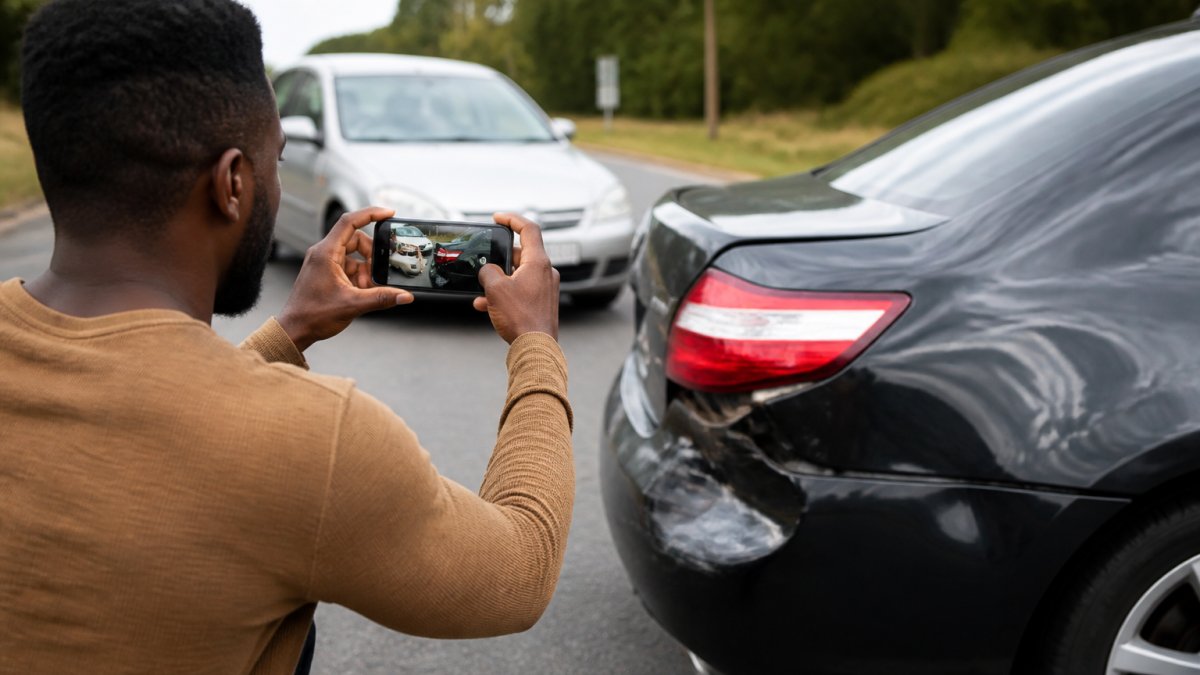
Walk a full circle around both vehicles. Shoot wide shots first, then close-ups.
Schedule a Free Consultation →
- Overall position of both cars in the lane
- Close-ups of every dent, scratch, and cracked light
- The other car’s license plate and VIN if visible
Get names and phone numbers from any witnesses and ask what they saw while it is fresh.
Step 5: What to Say to Insurance After an Accident
What to say to insurance after an accident should be short, factual, and limited. Report the crash to your own insurer promptly with the date, location, vehicles involved, and the police report number.
Then stop talking.
Adjusters for the other driver’s insurer may call within days, trained to gather statements that limit what their company pays.
- Do not admit fault, even casually
- Do not guess at speed, distance, or timing
- Do not accept a quick settlement before you know your repair costs
Keep a written log of every call: date, name, company, and what was said. If the claim becomes a dispute, that log is evidence.
Step 6: Filing Your Claim and Handling a Dispute Over Fault
Filing your claim is straightforward; getting a fair outcome is harder. You file with your own insurer, the other driver’s insurer, or both, and the two companies investigate.
In a rear end collision, the driver in back is typically presumed at fault. But that presumption can be challenged. If the other insurer argues you braked suddenly or had a malfunctioning taillight, they may assign you part of the blame.
That matters because of how shared fault works. Most states apply a comparative fault system, where your recovery is reduced by your share of fault. Under a typical state comparative negligence statute, a driver who is 50% or more at fault may recover nothing, while a 20% fault finding cuts your payout by 20%.
Situation | Likely Fault Split | Effect on Your Claim |
|---|---|---|
Clear rear-end impact, no brake-check claim | Other driver 100% | Full recovery of repair costs |
Disputed brake-check allegation | Often 80/20 or 70/30 | Recovery reduced by your share |
Broken taillight or non-working brake lights | Can rise to 50/50 | Recovery may be barred entirely |
Rear-end crash during a lane change | Split depends on signals and position | Negotiated case by case |
What Happens When Both Insurers Allege Fault
This is the scenario the generic guides skip. Your insurer says the other driver caused it; the other insurer says you did. Both companies are protecting their own policyholders, and you are stuck in the middle with a damaged car.
Here is the practical sequence that actually moves a disputed claim:
- Notify both insurers in writing. Report the crash to your own insurer and open a claim with the other driver’s insurer, giving each the date, location, vehicles involved, and the police report number. Ask for a claim number and the adjuster’s name.
- Send your evidence package to both adjusters. Do not wait to be asked. Send the police report, photos, witness contacts, dashcam footage, and repair estimates in one organized file, forcing the adjuster to evaluate facts rather than the other driver’s statement.
- Request each insurer’s liability decision in writing. Ask for the specific facts and policy language they relied on. An insurer that cannot articulate a basis for its fault finding is easier to challenge.
- Compare the two decisions. If your insurer finds the other driver 100% at fault but the other insurer finds you 50% at fault, that documented conflict is leverage, not a dead end.
- Escalate through the insurer’s internal complaint process. Put your request in writing, attach the conflicting decisions, and ask for a supervisor review.
- Escalate externally if the internal process stalls. Your state’s department of insurance accepts complaints about claim handling, and for property damage disputes small claims court is often the fastest, cheapest forum.
How Fault Percentages Affect Repair Costs and Settlement
A fault percentage is not just a number on a form. It directly changes what you recover.
Suppose your repair estimate is $4,000 and the other insurer assigns you 20% fault. Its share drops to $3,200.
If the split is disputed, the practical effect is delay: each insurer waits for the other to concede while your car sits unrepaired or you pay out of pocket.
A few mechanics worth knowing:
- Your deductible applies to your own collision claim, regardless of who was at fault. You may recover it later through subrogation, but not always.
- The other insurer pays only its driver’s share. If the other driver is 80% at fault, that insurer typically pays 80% of your repair cost, not 100%.
- Policy terms control the details. Whether your insurer waives your deductible, how subrogation works, and what your rental coverage pays all depend on your policy language.
Disputing an Insurer’s Liability Decision
If the other insurer denies liability or lowballs your repair estimate, you can push back through a structured process.
Step 1: Request the basis for the decision in writing. Ask the adjuster to explain the facts and policy provisions supporting the fault finding.
Step 2: Submit additional evidence. A witness statement, clearer photo, or dashcam footage contradicting the other driver’s account can flip a decision.
When to Speak With a Rear End Collision Attorney
Timing matters: personal injury claims are governed by a filing deadline, and once it passes, the claim is gone.
Merritt & Merritt Law Firm handles car accident and personal injury cases on a contingency basis: you pay only if we win.
If both insurers are pointing fingers and you are stuck in the middle, get a free case evaluation before you sign anything.
Frequently Asked Questions
What should I do immediately after a rear-end collision with no injuries?
Move your vehicle out of traffic if it is safe to do so, then turn on your hazard lights. Check on the other driver and passengers, and call 911 if anyone shows signs of injury. Exchange names, phone numbers, insurance details, and license plate numbers. Photograph the damage and the scene before leaving. Even without visible injuries, see a doctor within 24 to 48 hours, since soft tissue injuries and whiplash often take time to appear.
Do I need to call the police after a minor rear-end collision?
In most states, you must call police when the crash involves injury, death, or property damage above a certain dollar threshold, so check your state’s reporting rules. Even for a minor rear-end collision, a police report creates an official record that helps your insurance claim. If officers do not respond to the scene, you can file a report at the local station or through your state’s crash reporting system within the required timeframe.
Should I report a rear-end collision to my insurance company if there are no injuries?
Yes. Most policies require prompt notice of any accident, and delaying can give your insurer grounds to deny coverage. Reporting the crash does not automatically raise your rate, especially when the other driver was at fault. Give your insurer the facts, the police report number, and your photos, but avoid speculating about fault or accepting blame before the investigation is complete.
What if the other driver denies responsibility after a rear-end collision?
Rear-end crashes are usually presumed to be the following driver’s fault, but that presumption can be challenged. Preserve your evidence: photos, dashcam footage, witness contact details, and the police report. Notify your insurer and let them handle the dispute through the claims process. If the other insurer still denies liability or offers a low settlement, a car accident attorney can review your case and advise on next steps.
Our Locations

Atlanta/Decatur
1 West Court Square
Suite 750
Decatur, GA 30030

Savannah
100 Bull Street
Suite 200
Savannah, GA 31401
Statesboro
15 West Main Street
Statesboro, GA 30458
Houston
1415 Louisiana Street,
Suite 1800,
Houston, TX 77002

Jacksonville
841 Prudential Drive
12th Floor
Jacksonville, FL 32207

Contact Us
© Copyright 2026 Merritt & Merritt Law Firm. All rights reserved.