
call us 24/7 1-800-738-WE-WIN
call us 24/7 1-800-738-WE-WIN
Serving All of Georgia, Florida, & Texas
How to Prove Cargo Loading Negligence: A Legal Guide

Table of Contents
- What Cargo Loading Negligence Means in Trucking Accidents
- The Four Elements Required to Prove Cargo Loading Negligence
- FMCSA Cargo Securement Rules and How They Establish Liability
- Cargo Loading Negligence Examples From Real Trucking Accidents
- Collecting and Preserving Evidence in Trucking Accident Cases
- Building Your Case: Documentation and Expert Testimony
- Negotiating Your Settlement After Proving Negligence
- Conclusion: Taking Action on Your Cargo Loading Negligence Claim
Last Updated: August 14, 2026
What Cargo Loading Negligence Means in Trucking Accidents
Call the Merritt & Merritt Law Firm today at 404-975-1775. Offices: Atlanta/Decatur | Savannah | Statesboro | Houston.
Cargo loading negligence occurs when a carrier, shipper, or loading crew fails to secure freight properly, violating industry standards and creating dangerous conditions on the road. This type of negligence can cause catastrophic accidents when unsecured or improperly loaded cargo shifts, falls, or causes a truck to become unstable.
In trucking accidents, cargo loading negligence is distinct from driver error or mechanical failure. It focuses specifically on how cargo was prepared, loaded, and secured before the truck left the facility. When a truck’s cargo isn’t properly distributed, restrained, or documented, the entire vehicle becomes a hazard to every other vehicle sharing the road.
The legal significance of cargo loading negligence is substantial. Shippers and loaders have a duty to prepare cargo safely. When they breach that duty and someone gets injured, they become liable for damages. At Merritt & Merritt Law Firm, we’ve investigated hundreds of trucking accidents where negligent loading practices were the root cause. Many victims don’t realize they have a claim against the shipper or loading company, they focus only on the driver. That’s a critical mistake because the party responsible for loading often carries separate insurance and has deeper resources.
The Four Elements Required to Prove Cargo Loading Negligence
To hold a shipper or loading company liable for cargo loading negligence, you must establish four legal elements. Each one is essential; missing any single element weakens your case significantly.
1. Duty of Care The shipper or loading company owed you a duty to load cargo safely and in compliance with federal regulations. This duty exists regardless of whether the shipper knew you personally, it’s a duty owed to the public.
2. Breach of That Duty You must prove the defendant failed to meet the standard of care by violating FMCSA cargo securement rules, industry best practices, or common safety standards. A breach might involve overloading a truck beyond its weight capacity, failing to use proper tie-downs, or loading cargo unevenly so the truck’s center of gravity became unstable.
3. Causation You must establish a direct causal link between the breach and your injuries. For example, if cargo shifted during transit, causing the truck to jackknife and collide with your vehicle, causation is clear. Expert testimony often becomes necessary to establish this element.
4. Damages Finally, you must prove you suffered actual harm, medical expenses, lost wages, pain and suffering, or permanent disability. Without documented injuries and expenses, you have no basis for compensation even if you can prove negligence.
Courts and juries require clear evidence on all four elements, with documentation and expert analysis supporting every claim.
FMCSA Cargo Securement Rules and How They Establish Liability
The Federal Motor Carrier Safety Administration (FMCSA) publishes detailed cargo securement rules that establish the legal standard for how freight must be loaded and secured. When a shipper or loader violates them, that violation often constitutes negligence per se, meaning the violation itself proves negligence without requiring additional proof.
Weight Distribution and Limits Cargo must be loaded so the truck’s weight is distributed evenly. Overloading on one side creates an unstable vehicle prone to tipping. The regulations specify maximum weight limits for different truck configurations and axles.
Securement Methods Cargo must be secured with appropriate tie-downs, straps, or other restraint systems. The strength of these devices must be sufficient to prevent cargo movement during normal driving, braking, and turning. Different cargo types require different securement approaches.
Documentation Requirements Shippers must prepare and maintain accurate load documentation showing what cargo is aboard, its weight, and how it’s secured. Missing or inaccurate load sheets are red flags indicating negligent loading practices. When we investigate cargo loading negligence, we often find documentation is either missing or contradicts what was actually loaded.
Inspection Standards Before departure, someone must inspect the cargo and securement devices to ensure they meet standards. If the shipper or loader skipped this inspection or failed to catch obvious problems, that’s evidence of negligence.
FMCSA regulations establish an objective standard. You can point to specific regulatory violations rather than arguing that loading was merely “unreasonable.” This makes proving cargo loading negligence significantly easier than proving general negligence.
Cargo Loading Negligence Examples From Real Trucking Accidents
Uneven Weight Distribution A shipper loaded a flatbed trailer with construction equipment, placing heavy machinery on one side and lighter materials on the other. The truck became unstable during a turn, causing it to tip and collide with a passenger vehicle. Investigation revealed the shipper had no documented loading procedure and no weight calculations for the load.
Inadequate Securement A produce company loaded pallets of fruit into a refrigerated trailer using only two tie-down straps for a 35,000-pound load. During highway driving, the straps failed, and pallets shifted forward, striking the trailer’s front wall. The impact caused the truck to swerve, hitting another vehicle. FMCSA standards required four or more securement points for this type of load.
Exceeding Weight Limits A recycling facility overloaded a dump truck with scrap metal, exceeding the truck’s rated capacity by 15 percent. The overloaded truck had reduced braking capability and stability. When the driver attempted an emergency stop, the truck jackknifed, causing a multi-vehicle collision. Post-accident weighing confirmed the overload.
These examples share a common thread: someone responsible for loading made decisions that violated safety standards, and those decisions directly caused accidents that injured people.
Collecting and Preserving Evidence in Trucking Accident Cases
Evidence is everything in cargo loading negligence cases. You must act quickly to preserve evidence before it disappears, gets destroyed, or is altered.
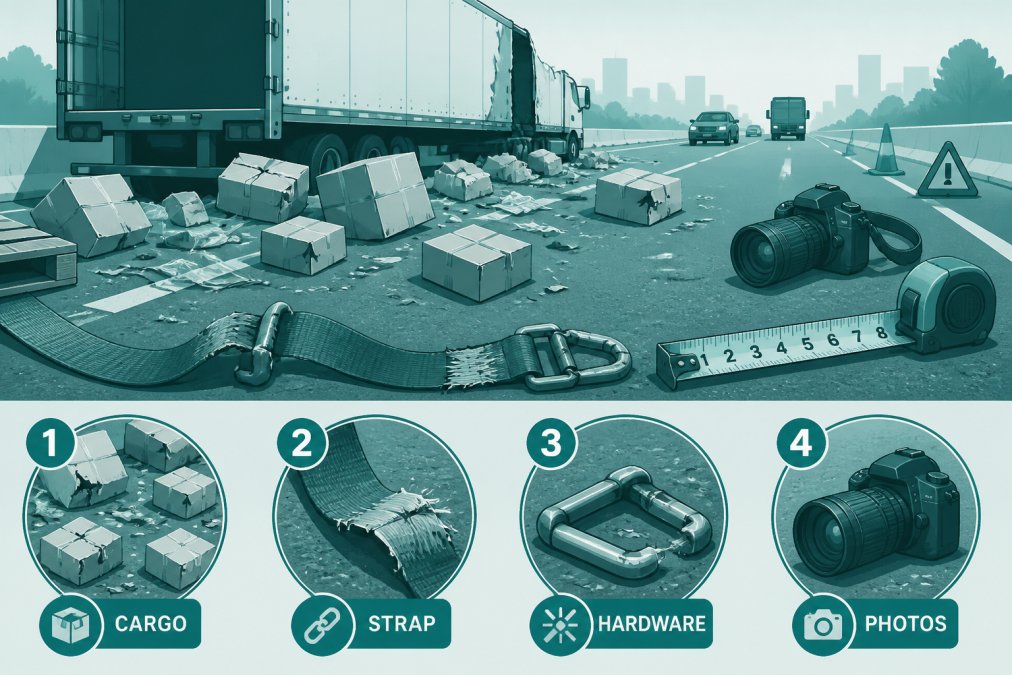
Scene Documentation Photograph everything: cargo scattered on the road, vehicle positions, damage patterns, and any visible securement failures. Take photos of broken tie-downs, torn straps, or shifted cargo from multiple angles. Document weather and road conditions.
Vehicle and Cargo Inspection Request that the vehicles involved be preserved and not repaired or scrapped. The truck’s cargo area, trailer, and any remaining cargo provide crucial evidence. An expert can examine securement devices, measure weight distribution, and identify what went wrong. Insurance companies and trucking companies want to repair or dispose of damaged vehicles quickly, often because it destroys evidence. A preservation letter from an attorney prevents this.
Schedule a Free Consultation →
Load Documentation Obtain the original bill of lading, load sheet, weight calculations, and any pre-trip inspection reports. Compare them to what actually happened. Discrepancies are evidence of negligence. Request these documents immediately through your attorney.
Witness Statements Identify and interview any witnesses to the accident or the loading process. Document your observations in writing immediately while details are fresh. Witness memories fade quickly.
Accident Reconstruction Reports An accident reconstruction expert can analyze the accident’s mechanics and determine what cargo conditions would produce the observed damage and vehicle movement. This expert testimony connects the improper loading to the accident, establishing causation.
Regulatory Records Obtain the shipper’s or loader’s FMCSA safety records, inspection history, and any prior violations. A pattern of cargo loading violations strengthens your case.
Acting quickly is critical. Evidence degrades, memories fade, and responsible parties destroy documentation. At Merritt & Merritt Law Firm, we move immediately to preserve evidence in trucking accident cases.
Building Your Case: Documentation and Expert Testimony
Once you’ve collected evidence, building your case requires organizing it into a coherent narrative and supporting it with expert analysis.
Organizing Your Documentation Create a timeline of events: when the cargo was loaded, when the truck departed, when the accident occurred, and when you received medical treatment. Separate your evidence into categories: pre-accident conditions (loading practices, documentation, weight records), accident evidence (scene photos, vehicle damage, witness statements), and post-accident evidence (medical records, repair estimates, expert reports).

Expert Testimony Cargo loading negligence cases almost always require expert testimony. A cargo loading expert can testify about industry standards, FMCSA compliance, and whether the cargo was loaded properly. An accident reconstruction expert connects the improper loading to the accident, explaining how the cargo condition caused the vehicle behavior observed. A medical expert documents your injuries and their relationship to the accident.
These experts provide the technical credibility your case needs. Juries understand that cargo loading negligence is complex, and expert testimony translates that complexity into understandable explanations.
Building the Narrative Present your evidence as a story: here’s what should have happened (proper loading standards), here’s what actually happened (the evidence you collected), here’s why that matters (expert analysis), and here’s what it cost you (your damages). This narrative structure is far more persuasive than a list of facts.
Negotiating Your Settlement After Proving Negligence
Once you’ve established cargo loading negligence through evidence and expert testimony, you’re in a position to negotiate a settlement.
Valuing Your Claim Your settlement value depends on the severity of your injuries, medical expenses, lost wages, permanent disability, and pain and suffering. Document every expense and every impact on your life. Medical records showing treatment, rehabilitation, and ongoing care support higher settlements.
Presenting Your Case to the Insurance Company Prepare a demand package that presents your evidence in organized form. Include a cover letter explaining the liability evidence, copies of key documents, expert reports, medical records, and a detailed damages calculation. This package should be thorough and professional.
Negotiation Strategy Start with a demand higher than your target settlement. Insurance companies expect negotiation and will counter-offer lower. Be prepared to justify every number. Don’t accept the first offer, insurance companies often make low initial offers to test whether you’ll accept quickly. Respond with a detailed explanation of why the offer is insufficient.
When Settlement Isn’t Appropriate Sometimes the insurance company’s position is so unreasonable that settlement isn’t possible. If the company denies liability despite strong evidence, or if their settlement offer is drastically below your damages, litigation may be necessary.
Conclusion: Taking Action on Your Cargo Loading Negligence Claim
Proving cargo loading negligence requires understanding the legal elements, collecting thorough evidence, and presenting expert analysis that connects improper loading to your injuries. The FMCSA regulations provide an objective standard that makes these cases provable when you have the right evidence and expertise.
If you’ve been injured in a trucking accident involving cargo loading negligence, don’t delay. Evidence disappears, memories fade, and responsible parties destroy documentation. Merritt & Merritt Law Firm specializes in trucking accident cases and understands the specific evidence needed to prove cargo loading negligence. We offer immediate case evaluation, investigate claims thoroughly to hold liable parties responsible, and work toward timely settlements that reflect the true value of your injuries. With over 45 years of trial experience and 24-hour availability, we’re prepared to fight for your compensation. Schedule a free consultation today, you pay only if we win.
Frequently Asked Questions
What are the four elements required to prove negligence in a cargo loading case?
To prove cargo loading negligence, you must establish: (1) the defendant owed you a duty of care—typically the trucking company or loader's responsibility to secure cargo properly; (2) the defendant breached that duty by failing to follow FMCSA regulations or industry standards; (3) that breach directly caused your accident and injuries; and (4) you suffered actual damages, including medical bills, lost wages, and pain and suffering. Each element must be proven with evidence such as inspection reports, witness statements, and expert analysis of how improper loading contributed to the collision.
How do FMCSA cargo securement rules help prove liability?
FMCSA regulations establish specific, federally mandated standards for how cargo must be loaded, secured, and distributed on trucks. When a cargo loading negligence case goes to court, proof that the defendant violated these rules—such as failing to use proper tie-downs, exceeding weight limits, or improperly distributing load—demonstrates breach of duty directly. Violation of FMCSA standards is powerful evidence because it shows the defendant knowingly disregarded established safety requirements, making it easier to establish that negligence caused your accident and injuries.
What evidence do I need to collect at the accident scene?
Collect photographs and video of the cargo, debris field, vehicle damage, and overall scene from multiple angles. Obtain the truck's cargo manifest and bill of lading to verify what was loaded and how much weight was on board. Get the names and contact information of witnesses, including other drivers and bystanders. Request the police report, which often documents scene conditions. If possible, note weather conditions and road surface. Preserve any physical evidence like cargo straps, packaging materials, or spilled freight. This documentation forms the foundation for proving how improper loading caused the accident.
Can I still pursue a cargo loading negligence claim if I'm in the hospital?
Yes. Merritt & Merritt Law Firm offers 24-hour service and can visit you in the hospital, home, or office to begin your case evaluation and evidence gathering immediately. Early legal intervention is actually beneficial because it ensures evidence is preserved while the accident scene is still fresh and witnesses are more accessible. Your attorney can coordinate with investigators and medical providers on your behalf while you focus on recovery. Waiting longer makes evidence collection harder and can hurt your case, so reaching out promptly protects your rights.
Our Locations

Atlanta/Decatur
1 West Court Square
Suite 750
Decatur, GA 30030

Savannah
100 Bull Street
Suite 200
Savannah, GA 31401

Statesboro
15 West Main Street
Statesboro, GA 30458

Houston
1415 Louisiana Street,
Suite 1800,
Houston, TX 77002

Jacksonville
841 Prudential Drive
12th Floor
Jacksonville, FL 32207

Contact Us
© Copyright 2026 Merritt & Merritt Law Firm. All rights reserved.