
call us 24/7 1-800-738-WE-WIN
call us 24/7 1-800-738-WE-WIN
Serving All of Georgia, Florida, & Texas
Best Personal Injury Attorney Georgia: 2026 Guide

Table of Contents
- What Makes the Best Personal Injury Attorney in Georgia
- Types of Personal Injury Cases Georgia Attorneys Handle
- Georgia Personal Injury Statute of Limitations: What You Need to Know
- Personal Injury Lawyer Contingency Fee Structure in Georgia
- What to Do After a Car Accident in Georgia: Step-by-Step
- Average Personal Injury Settlement in Georgia: What to Expect
- How to Choose the Best Personal Injury Attorney for Your Case
- Common Mistakes to Avoid When Selecting Legal Representation
- Semantic Coverage & External Sources
- Frequently Asked Questions
Best Personal Injury Attorney Georgia: 2026 Guide
Last Updated: July 9, 2026
When you’re injured due to someone else’s negligence, finding the best personal injury attorney Georgia can mean the difference between a fair settlement and accepting far less than you deserve. Insurance companies deploy teams trained to minimize payouts. At Merritt & Merritt Law Firm, we’ve spent over 45 years holding liable parties accountable and securing compensation for injury victims across Georgia. This guide shows you how to identify which attorney matches your specific case.
Call us today at 404-975-1775.
What Makes the Best Personal Injury Attorney in Georgia
Trial experience separates exceptional attorneys from mediocre ones. Insurance adjusters know which firms will litigate, and they make their first offer accordingly. A lawyer who has never taken a case to verdict lacks credibility in settlement negotiations.
The best personal injury attorney Georgia combines courtroom readiness with practical settlement acumen. A firm that fights cases other attorneys have given up on will show higher average settlements because they’ve pushed cases further.
Trial Experience and Track Record
Your attorney’s trial record matters more than their win-loss percentage. At Merritt & Merritt Law Firm, over 45 years of trial experience means we’ve handled catastrophic injuries, wrongful death cases, and complex liability disputes. When insurance adjusters know we’ll spend six figures preparing for trial if necessary, their opening offers improve significantly.
The specific types of cases your attorney has tried matter too. A lawyer with extensive experience in slip-and-fall cases may lack the medical knowledge for a complex product liability claim.
Client Accessibility and Support
Accessibility defines the client experience. When you’re injured, you shouldn’t have to drive to a law office during business hours. The best personal injury attorney Georgia makes themselves available when you need them.
Merritt & Merritt Law Firm offers 24-hour service and home, office, or hospital visits. When you’re recovering from a serious injury, traveling to a law office becomes a burden your body can’t handle.
Types of Personal Injury Cases Georgia Attorneys Handle
A comprehensive personal injury attorney Georgia should handle multiple practice areas: car and truck accidents, slip and fall cases, medical malpractice claims, wrongful death cases, product liability, dog bites, workplace injuries, and nursing home negligence. The best personal injury attorney Georgia has handled enough variety to recognize patterns across case types.
Georgia Personal Injury Statute of Limitations: What You Need to Know
Time is your enemy in personal injury cases. Georgia law imposes strict deadlines for filing suit, and missing these deadlines eliminates your right to compensation entirely.
For most personal injury claims in Georgia, the statute of limitations is two years from the date of injury. Medical malpractice claims carry a different timeline: two years from discovery of the injury, but no more than four years from the negligent act itself. Wrongful death claims follow the two-year rule from the date of death.
Evidence also degrades over time. Surveillance footage gets deleted after 30 days, and witnesses move away or forget details. An attorney who waits months to investigate loses critical evidence.
Personal Injury Lawyer Contingency Fee Structure in Georgia
Understanding how personal injury attorneys charge is essential. The contingency fee model, where you pay only if you win, is standard in Georgia personal injury law.
How Contingency Fees Work
Under a contingency fee arrangement, your attorney advances all case costs and receives payment only if you recover compensation. The fee is typically a percentage of your settlement or jury verdict, ranging from 25% to 40% depending on case complexity.
Here’s how it works: You’re injured in a car accident and hire an attorney who agrees to a 33% contingency fee. Your case settles for $100,000. The attorney receives $33,000, and you receive $67,000 after deducting medical liens and other obligations.
If your case goes to trial and you lose, you owe nothing. This creates alignment between your interests and your attorney’s interests. Most firms also charge clients for out-of-pocket expenses: court filing fees, expert witness fees, and medical record retrieval. These costs are typically deducted from your settlement, separate from the attorney’s contingency fee.
Why No Win, No Fee Matters
The “no win, no fee” guarantee eliminates the financial barrier to legal representation. This structure also filters out frivolous cases. An attorney working on contingency won’t take cases they don’t believe in, because they’ll invest time and money with zero return.
At Merritt & Merritt Law Firm, our contingency fee model reflects our confidence in securing results. You pay only if we win.
What to Do After a Car Accident in Georgia: Step-by-Step
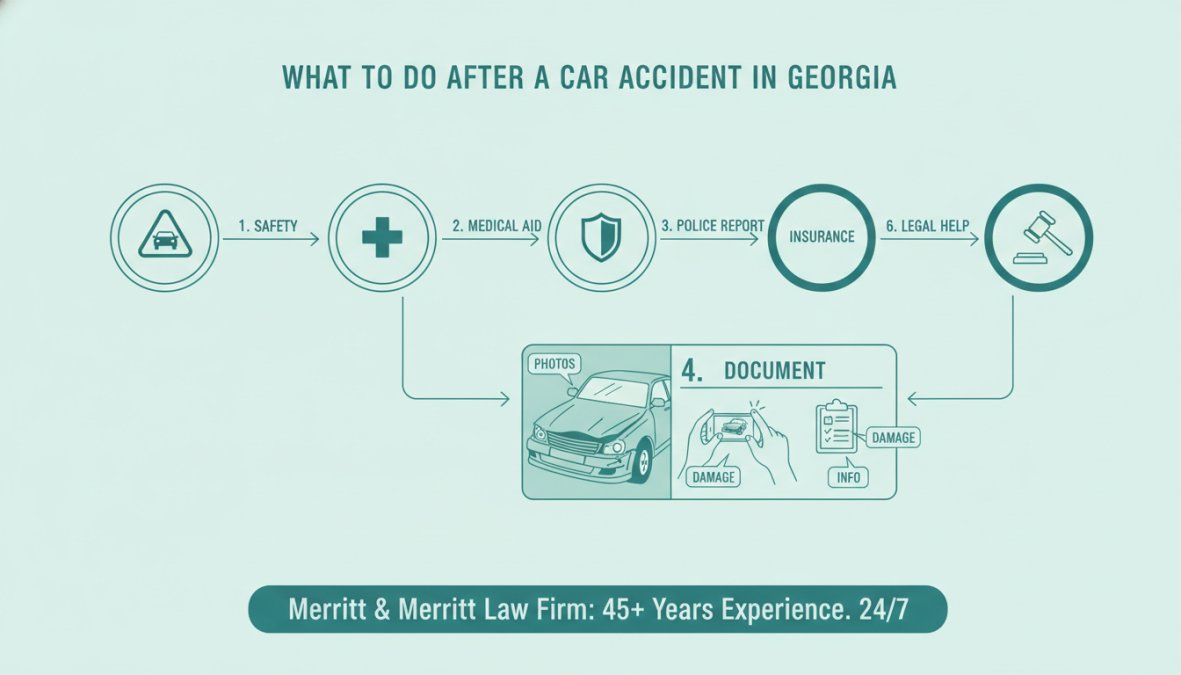
The first hours after a car accident determine whether you have a strong case. Your actions at the scene, your medical decisions, and your communication with insurance companies all impact settlement value.
Immediate Actions at the Scene
Step 1: Ensure safety. Move to a safe location away from traffic if possible. If injuries are severe, call 911 immediately.
Step 2: Call police. In Georgia, you’re required to report accidents involving injury or property damage exceeding $500. The police report creates an official record that insurance companies and courts rely on.
Step 3: Document everything. Take photographs of vehicle damage, road conditions, traffic signals, and the accident scene from multiple angles. Photograph the other driver’s license plate, VIN, and driver’s license. Get contact information from all parties and witnesses.
Step 4: Avoid admissions. Do not apologize, accept blame, or discuss fault at the scene. Keep conversation limited to exchanging insurance information.
Step 5: Seek medical attention. Even if you feel fine, get a medical evaluation. Some injuries like whiplash and traumatic brain injury don’t manifest immediately. A medical record created within days of the accident establishes the injury’s connection to the accident.
Working with Insurance Adjusters
Insurance adjusters are trained negotiators whose job is minimizing payouts. They’ll contact you within days, often before you’ve fully understood your injuries.
What to expect: The adjuster will request a recorded statement about the accident, your injuries, and your medical history. Everything you say will be documented and used to minimize your claim.
What to do: Provide basic information required by law, but decline to give a recorded statement without attorney representation. You’re not required to provide one, and doing so without legal counsel almost always reduces settlement value.
Common tactics: Adjusters may offer a quick settlement within weeks, framing it as “final” and suggesting you’ll lose this offer if you hire an attorney. Quick settlements are typically 30-50% below fair value because you haven’t fully understood your injuries.
A personal injury attorney Georgia will handle all communication with insurance adjusters on your behalf.
Average Personal Injury Settlement in Georgia: What to Expect
Settlement values vary based on injury severity, liability clarity, and insurance coverage.
Minor injuries (soft tissue damage, brief treatment): $5,000-$25,000 Moderate injuries (fractures, surgery required): $25,000-$100,000 Serious injuries (permanent disability, chronic pain): $100,000-$500,000+ Catastrophic injuries (paralysis, brain damage, wrongful death): $500,000-$5,000,000+
Your specific settlement depends on medical expenses, lost wages, pain and suffering, permanent impairment, and liability strength. Insurance coverage limits act as a ceiling. If the at-fault driver carries $25,000 in liability coverage and your damages exceed that, you can pursue underinsured motorist coverage.
How to Choose the Best Personal Injury Attorney for Your Case
Selecting the best personal injury attorney Georgia requires evaluating multiple factors beyond reputation.
Evaluating Experience and Specialization
Ask specific questions about case experience: How many cases similar to mine have you handled in the past three years? What was the average settlement or verdict in those cases? Have you tried cases to jury verdict in the past two years? Which insurance companies have you negotiated with most frequently?
The best personal injury attorney Georgia can point to specific cases and explain their strategy and results. Specialization matters. Firms that focus on specific injury types develop deeper knowledge of case strategy and settlement benchmarks.
Checking Reviews and Client Testimonials
Online reviews provide valuable signals. Look for patterns in whether clients mention specific outcomes, communication, and accessibility. Google reviews, Avvo, and the State Bar of Georgia’s public records provide different perspectives. Ask for client references directly. A firm confident in their work will provide contact information for past clients willing to discuss their experience.
Scheduling Your Free Consultation
Most personal injury attorneys Georgia offer free consultations. During the consultation, pay attention to whether the attorney listens carefully and asks detailed questions, explains realistic expectations without promising specific amounts, clarifies fee structure and expenses in writing, and outlines your communication plan and next steps.
Trust your instincts. You’ll be working closely with this attorney for months or years, so personal fit matters.
Common Mistakes to Avoid When Selecting Legal Representation
Waiting too long to hire representation. Every day you delay, evidence disappears and memories fade. Hire an attorney within weeks of your injury.
Accepting the first settlement offer. Insurance companies make low initial offers intentionally. Never respond to a settlement offer without attorney input.
Giving recorded statements to insurance adjusters. You’re not required to give a recorded statement, and doing so without attorney counsel almost always reduces your settlement.
Hiring based on advertising spend. The firms with the biggest billboards aren’t necessarily the best. They’re the best at marketing.
Choosing an attorney who doesn’t specialize in personal injury. A general practice attorney won’t have the depth of expertise a specialist brings.
Not discussing trial readiness. If your attorney has never tried a case, they’ll be at a disadvantage in settlement negotiations.
Ignoring fee structure details. Understand exactly what percentage the attorney takes, what expenses you’re responsible for, and how the settlement gets divided.
Finding the best personal injury attorney Georgia means identifying a firm with genuine trial experience, proven track record, and commitment to accessibility. When you’re injured, you need representation that understands Georgia law, knows how to negotiate with insurance companies, and will fight for every dollar you deserve. Merritt & Merritt Law Firm combines over 45 years of trial experience with 24-hour availability and contingency-fee representation. Schedule your free consultation today to discuss your case.
Semantic Coverage & External Sources
The framework for evaluating personal injury representation in Georgia relies on understanding how liability, negligence, and damages interact under Georgia tort law. According to Georgia’s Statute of Limitations for Personal Injury Cases, the two-year filing deadline applies to most injury claims, making immediate legal consultation critical for preserving your rights.
Settlement calculations balance economic damages (medical bills, lost wages) against non-economic damages (pain and suffering). Research from the American Association for Justice on Personal Injury Settlements shows that represented injury victims recover significantly more than unrepresented ones, often 3-5 times higher settlements when professional negotiation replaces direct insurance company contact.
Insurance defense strategies have evolved substantially. Data from the National Association of Insurance Commissioners on claims handling practices indicates that early settlement offers from insurance companies average 40% below fair value, reinforcing the importance of attorney representation before accepting any offer.
Selection Criterion | What to Evaluate | Red Flags |
|---|---|---|
Trial Experience | Cases tried to verdict in past 2 years | “We settle most cases” without trial readiness |
Specialization | Focus on your specific injury type | Generalist handling 5+ practice areas |
Fee Structure | Contingency percentage and expense responsibility | Vague about costs or hidden fees |
Accessibility | 24-hour availability and communication frequency | Office hours only, delayed responses |
Track Record | Specific settlements/verdicts in similar cases | Refuses to share case examples |
Client References | Past clients willing to discuss experience | Unwillingness to provide references |
Frequently Asked Questions
How do I choose the best personal injury attorney in Georgia?
Look for a personal injury attorney with substantial trial experience, a proven track record of successful settlements and verdicts, and a contingency fee structure. Verify they handle cases similar to yours, check client testimonials and reviews, and ensure they offer accessibility through free consultations. Many of the best personal injury attorneys in Georgia provide 24-hour availability and will meet you at your home, office, or hospital for convenience.
What percentage do personal injury lawyers take in Georgia as a contingency fee?
Personal injury lawyer contingency fee arrangements in Georgia vary by firm and case complexity. Rather than a fixed percentage, fees depend on factors like case difficulty, settlement timing, and whether litigation goes to trial. Since you only pay if your attorney wins, it’s essential to discuss the specific fee structure during your free consultation. Always ask for transparency about how costs are calculated and what expenses may apply.
How long do I have to file a personal injury claim in Georgia?
Georgia personal injury statute of limitations generally allows two years from the date of injury to file a lawsuit. However, this timeline varies depending on the type of case—wrongful death claims, for example, may have different deadlines. Contacting a personal injury attorney promptly is critical because waiting too long could result in losing your right to compensation. Don’t delay: schedule a free consultation to understand your specific deadline.
What is the average personal injury settlement in Georgia?
Average personal injury settlement amounts in Georgia depend on case specifics: injury severity, medical bills, lost wages, pain and suffering, and liability strength. Minor cases might settle for thousands, while catastrophic injuries can yield significantly more. Rather than relying on averages, consult with a personal injury attorney who can evaluate your unique circumstances. They’ll provide realistic expectations based on comparable cases and your damages, ensuring you understand what fair compensation looks like.
Our Locations

Atlanta/Decatur
1 West Court Square
Suite 750
Decatur, GA 30030

Savannah
100 Bull Street
Suite 200
Savannah, GA 31401

Statesboro
15 West Main Street
Statesboro, GA 30458

Houston
1415 Louisiana Street,
Suite 1800,
Houston, TX 77002

Jacksonville
841 Prudential Drive
12th Floor
Jacksonville, FL 32207

Contact Us
© Copyright 2026 Merritt & Merritt Law Firm. All rights reserved.